Dimitrios Ainian
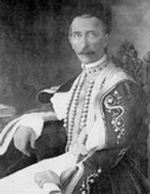
Dimitrios Ainian
Dimitrios Ainian (1800-1881). Dimitrios Oikonomou was born in Mavroilo, Tymfristos, as the youngest child of Father Zacharias Oikonomou. The surname Ainian, meaning "Phocian," was adopted by the family patriarch at an unknown date. In 1806, the family moved to Constantinople, where his father was appointed director at the School of the Nation in Therapia, and later at the School of Kuru Çeşme. In 1818, Dimitrios was initiated into the Filiki Eteria, a secret organization his father and two brothers, Georgios and Christodoulos, were already part of. After facing persecution, he fled to Odessa and arrived in Greece in 1822, where he served in the War of Independence, initially as a soldier and later as a secretary for the Executive and the National Assembly Committee, and as a scribe for Georgios Karaiskakis from 1826. In the newly established Greek state, he served as secretary to the Extraordinary Commissioner of Achaia, a member of the Court of Appeals of the Islands during Kapodistrias' governance, and as a president of the court in Lamia, a position he resigned from in 1835 following King Otto's expression of distrust towards him. He retired to his estate in Ypati, engaging in agricultural and political activities against the regime. This led to the looting of his home, disfavor from the Palace, and severe financial difficulties. In 1850, he was elected as a Member of Parliament, but after the annulment of his election by the Palace, he moved to Athens. There, he engaged in publishing and journalism (as publisher and editor of the magazine "Library of the People" and collaborator with the newspapers "Athena" and "The Panhellenion"), while also working as a Councillor of the Audit Office and a department head at the Ministry of the Interior. With great effort, he secured a meager state pension, and in 1863, after King Otto's dethronement, he was elected as a representative of Phthiotis in the Second National Assembly. After several relocations between Athens and Ypati, he finally settled in the capital in 1878, where he spent the rest of his life in poverty. He died in Stylida. Dimitrios Ainian's life is fundamentally characterized by his concern for the progress of the Greek people. During his political career, he advocated for the establishment of printing houses, bookbinding workshops, and schools in the Greek provinces and refused to engage in electoral tactics and clientelism. He first appeared in literature with the publication of the poem "Ode to Messolonghi" in the newspaper "General Gazette of Greece" on the day of the Exodus. His body of work also includes linguistic, biographical, agricultural, and historical studies, and in literature, short stories, most of which were published in his magazine "Library of the People." Ainian's narrative work is situated in the realm of social prose, with a particular focus on the living conditions of rural populations. Key features of his work include realistic writing, socio-political reflection, and a conscious commitment to didacticism and moral exemplification, avoiding any literary style. For more biographical details on Dimitrios Ainian, see Markos Gkiolias, "Ainian Dimitrios," Great Encyclopedia of Modern Greek Literature1. Athens, Haris Patsis, 1968, Takis Kayalis, "Dimitrios Ainian," Our Older Prose; From its beginnings to the First World War D' · 1830-1880, pp. 116-133. Athens, Sokolis, 1996, Kapsalis Ger.D., "Ainianes," Great Greek Encyclopedia 2. Athens, Pyrso, 1927, Mazarakis I.K. Ainian, "Chronology - Introduction," Dimitrios Ainian, O Karaiskakis. Athens, Hermes, 1974 and Mazarakis - Ainian Ioannis, "Ainian Dimitrios," World Biographical Dictionary 1. Athens, Ekdotiki Athinon, 1983. (Source: Archive of Greek Authors, E.KE.VI.).
-
Greek Fiction Books
-

All categories

Categories
 Greek Fiction Books
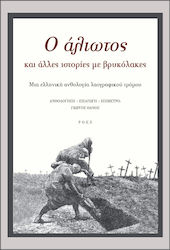
Aliotos and Other Vampire Stories
Dimitrios Ainian, Gerasimos Grigoris et al., 2024 , Flows
from9,65 € at 15 stores0