Nikiforos Vrettakos
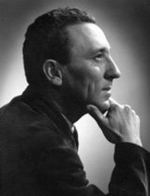
Nikiforos Vrettakos
Nikiforos Vrettakos (1912-1991) was born in the village of Krokees in Laconia, the second son of Konstantinos Vrettakos and Eugenia, née Panteleaki. He spent his school years in Krokees and Gytheio, graduating from the Greek School of Gytheio in 1927. In 1928, at just sixteen years old, he delivered two lectures at the Gytheio Commercial Club on the topic "Christianity - Marxism." In 1929, he moved to Athens to pursue his studies, but financial difficulties, exacerbated by his father's illness and bankruptcy, prevented him from doing so. He settled in Kato Patisia and, with the help of his childhood friend Thalis St. Koutoupis, was employed by the hydraulic works company responsible for draining the Tiryns swamp in Laconia. From 1930 to 1931, he took on various odd jobs, mainly manual labor, to make ends meet, while also engaging in self-study out of personal interest. In 1932, he enlisted in the army in Tripoli for four months, as he was the breadwinner for a large family. In 1934, he worked as a clerk in the general army warehouses in Piraeus, where he met Kalliopi Apostolidi, whom he married that same year. They had a daughter, Jenny, and a son, Kostas. In 1935, he worked at the Nea Ionia Silk Mills and a year later as a private employee and textile factory worker. In 1938, he was appointed to the Ministry of Labor through the intervention of his friend Themos Amourgi. In 1940, he was drafted to the front lines and narrowly escaped death at the height of Kleisoura. In 1941, after the dissolution of his regiment, he returned to Athens on foot. His diary entries from this period formed the basis of his book "The Wild Beast." From 1942 to 1944, he actively participated in the National Resistance, joining the E.A.M. and enrolling in the K.K.E. During this time, his father passed away and was buried in Ploumitsa. In 1946, he was hired as a clerk at the Piraeus Customs Brokers' Economic Cooperative. That same year, he signed a protest by Greek writers "To the Fourth Revisional Parliament of the Greeks and the International Public Opinion: On Extraordinary Measures Against Those Threatening Public Order and the Integrity of the Country." In 1948, he met Angelos Sikelianos, who remained a friend until the end of his life. In 1958, following his trip to Russia, he published the book "One of the Two Worlds," which led to accusations (along with Yiannis Ritsos and Markos Avgeris) of violating Law 509. In 1949, he published the lyrical essay "Two People Talk About World Peace," which resulted in his expulsion from the KKE and his removal from the magazine "Free Letters," where he was the director. During this time, he became friends with Tatiana Gritsi-Milliex and Roger Milliex. In 1954, his wife was dismissed from her position at the Piraeus Port Authority due to her political beliefs. During the 1955-1956 school year, he was forced to work at a school in Ioannina. After appealing to the Council of State, she returned to her former position. In 1955, Vrettakos was elected to the Piraeus Municipality (1955-1959). His contribution from this position was significant in the cultural enhancement of the city (establishment of the Piraeus Theater by Dimitris Rondiris, Historical Archive, Piraeus Philharmonic, Municipal Art Gallery). In 1957, he traveled to the Soviet Union with Stratis Myrivilis, Agis Theros, L. Koukoulas, and others. During the World Meeting of Democratic Youth, he was invited by the students of Moscow. In Moscow, he met the wife of Maxim Gorky. In 1961, he visited his father's grave in Ploumitsa. In 1962, the Customs Brokers Cooperative was dissolved, leaving Vrettakos unemployed. In 1964, he worked as a wardrobe keeper at the National Theatre through the intervention of Loukis Akritas. After the 1967 coup, Vrettakos self-exiled to Switzerland, from where he traveled across Europe (Bucharest, Venice, Dalmatian coast, Zagreb, Rome, Paris, Birmingham, London, Palermo, Munich). During his stay in Europe, he participated in radio broadcasts and poetry festivals, was honored by European universities, and worked on the autobiographical text "Odyni," published in 1969 in New York. He returned to Greece in 1974 and settled permanently in Athens. In the summer of 1991, he visited Ploumitsa with his wife, daughter, and her family. He died there in August from cardiac arrest. His funeral was held at the First Cemetery of Athens at public expense. Nikiforos Vrettakos made his debut in the literary world in 1929 with the publication of some early poems from his school years titled "Under Shadows and Lights" (published in 1933). By 1940, he had published six collections, which he compiled in the volume "Grimaces of Man." Many poetry collections followed until 1951 (a year considered a second milestone in his artistic journey), when he published the second collected volume of his poems titled "The Poems 1929-1951." From this period, his poetry collection "Ploumitsa" (1950) is indicative of Vrettakos's shift from youthful lyricism to simple and intensely dramatic writing. This was followed by the third and most mature period of his creation, where he attempted to balance lyrical and dramatic elements in the service of his moral and social concerns. Notable works include "To Robert Oppenheimer" (1954), "The Depth of the World" (1961), "The Distinguished Planet" (1983), "Meeting with the Sea" (1991). He also engaged in prose, criticism (in 1960, he published the study "Nikos Kazantzakis. His Agony and His Work"), and journalism. From 1946 to 1949, he worked at the magazine "Free Letters" (initially in the book column, later as editor-in-chief, publisher, and director). He subsequently collaborated with magazines and newspapers such as "Progressive Change" (1951, under the pseudonym Thymosophos), "Greek Chronicles" (1952-1954), "Art Review" (1956), "Independent Press" (1958), "Science and Life" (1959), "Roads of Peace" (1961), "World" (1962), "Eleftherotypia" (1975). He was honored with the First State Prize for Poetry (1940, 1956, 1982), the Ouranis Prize of the Academy of Athens (1974), the Knocken Prize and the Prize of the Society of Sicilian Letters and Arts (1980), the Literary Excellence Award from the Academy of Athens (1982), the Cross of the Apostle and Evangelist Mark from the Patriarchate of Alexandria and All Africa (1984), and the Golden Pegasus Medal from the Panhellenic Union of Writers (1989). He was a member of the judging committee for the New Greek Writers competition. Nominated four times for the Nobel Prize in Literature, he was honored by many municipalities across Greece and was declared honorary president of the Society of Greek Writers alongside Yiannis Ritsos and Giorgos Valetas (1984). He also served as honorary president of the Society of Letters and Arts of Piraeus, was an honorary member of Parnassos, a member of the Academy of Athens, and an honorary doctor of the Department of Philology at the National and Kapodistrian University of Athens (1991). For more biographical details on Nikiforos Vrettakos, see Alexandros Argyriou, "Vrettakos Nikiforos," in "World Biographical Dictionary," vol. 2, Athens, Ekdotiki Athinon, 1984; Georgia Kakourou - Chroni, "Chronology of Nikiforos Vrettakos," in "Memory of the Poet Nikiforos Vrettakos (1912-1991)," ed. P.D. Mastrodimitris, Athens, 1993; and Alexis Ziras, "Vrettakos Nikiforos" in "Dictionary of Modern Greek Literature," Athens, Patakis, 2007, pp. 333-334. (Source: Archive of Greek Writers, EKEBI).
0
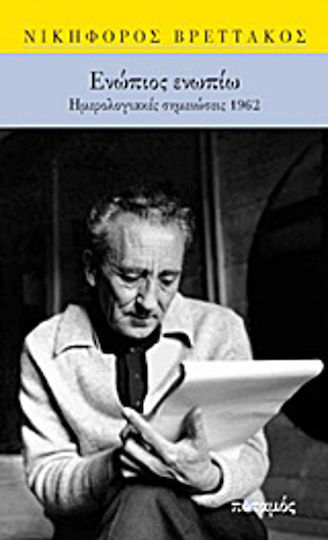 Greek Fiction Books
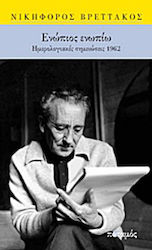
Ενώπιος Ενωπίω, Calendar Notes 1962
Nikiforos Vrettakos, 2012 , River
from4,90 € at 3 stores0
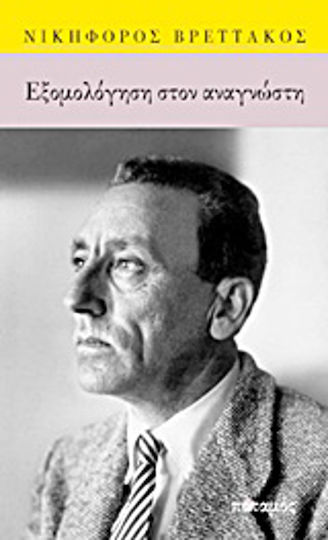 Greek Fiction Books
Εξομολόγηση στον Αναγνώστη
Nikiforos Vrettakos, 2012 , River
from5,11 € at 3 stores0
0
0
0
0
- Greek Fiction Books
Η Κριτική για τον Πέτρο Χάρη
Collective Work, 2009 , Kostas and Eleni Ouranis Foundation
0
