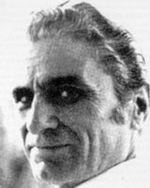
Gerasimos Grigoris
Gerasimos Grigoris (1907-1985). Gerasimos Grigoris was born in Spanohori Sfakioton, Lefkada, the son of Dimitrios Grigoris, and grew up in a rural environment. He completed his secondary education in the town of Lefkada and then studied philology at the Faculty of Philosophy at the University of Athens, while also taking courses in painting and engraving. During the Greco-Italian War, he served on the Albanian front and participated in the national resistance, joining the National Liberation Front (EAM) from 1943 to 1946. He married Aikaterini Politou, with whom he had two sons. Professionally, he worked in journalism and was a member of the Union of Periodical Press Editors, the Society of Greek Writers (vice president in 1979), and the Society for Lefkadian Studies. He was awarded the State Prize for Prose (1959 for the short story collection "The City Uncovered") and the First State Prize for Short Story (1964 for the collection "Beyond the Shore"), as well as a prize from the Academy of Athens for his study "Aristotelis Valaoritis" (1977). He was also involved in translating ancient drama, folklore, sketching, and philological studies. His works have been translated into German, Romanian, Swedish, Hungarian, Russian, and Bulgarian. He passed away in Athens. Grigoris made his literary debut during his student years in Athens, publishing poems in magazines, and in 1929 he published the short story "My Horse" in the magazine "Hellenic Letters." In 1939, he published the short story collection "Journey Through the Night." Chronologically, Grigoris's work can be placed in the interwar Greek literature. He stood in contrast to the renewal of both poetry and prose by the so-called Generation of the '30s, continuing the tradition of the early 20th century and the Greek short story tradition of the 1880s. His prose is characterized by social realism akin to authors like Kostas Paroritis, Konstantinos Theotokis, and Demosthenes Voutyras, though without an emphasis on social critique or sociological perspective. His writing often draws on personal experiences and covers themes of urban and rural life (with an emphasis on nature as an archetypal force) and the historical period of World War II and the occupation. His attempts in the realm of evocative atmosphere, dreams, and science fiction are also noted. For more biographical details on Gerasimos Grigoris, see Takis Doxas, "Grigoris D. Gerasimos," Great Encyclopedia of Modern Greek Literature 6. Athens, Haris Patsis, n.d., Spyros Kokkinis, "In Memory of Gerasimos Grigoris," Periplous 28-29 (Zakynthos), 1-6/1991, pp. 13-14, Vangelis Chatzivasileiou, "Gerasimos Grigoris," Interwar Prose: From the First to the Second World War (1914-1939) Vol. III, pp. 196-214. Athens, Sokolis, 1992, and n.a., "Grigoris Gerasimos," World Biographical Dictionary 3. Athens, Ekdotiki Athinon, 1985.
(Source: Archive of Greek Writers, EKEBI).
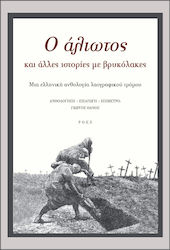
 Greek Fiction Books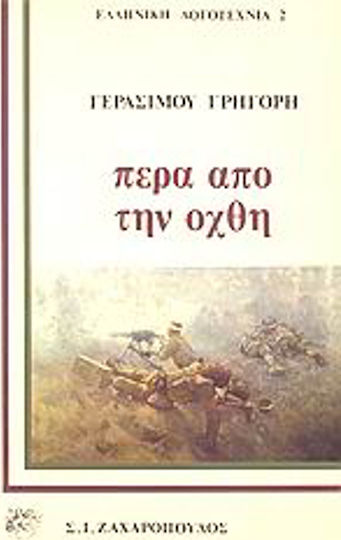
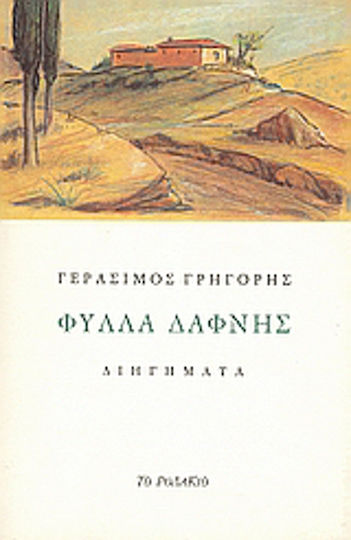
 Greek Fiction Books