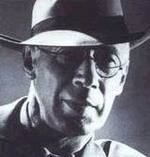
Henry Miller
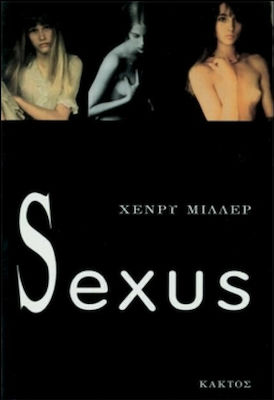
Author Henry Miller was born on December 26, 1891, in New York City. His father, Heinrich Miller, was a tailor. His mother, Louise Nieting Miller, never showed much affection towards her son and often beat her children, including Miller's sister, who had a mental disability. In school, Miller was an excellent student. At 17, he visited a brothel for the first time and contracted gonorrhea. Miller was a natural rebel. He said, "From 5 to 10 were the most important years of my life. I lived on the streets and acquired the spirit of a typical American gangster." With the money his father gave him for college, Miller traveled to the Southwest and Alaska. Upon returning, he went to work at his father's tailor shop but left after trying to unionize the workers. He opened a "speakeasy" in Greenwich Village, but that too proved unsuccessful. In 1917, Miller married Beatrice Sylvas Wickens, an amateur pianist, and became a father. He also had a brief affair with his mother-in-law. From 1920 to 1924, Miller worked at the Western Union Telegraph Company. He left his family to live with June Mansfield Smith, a Broadway dancer who encouraged his literary ambitions. Their relationship inspired Miller's early narratives "Moloch" and "Crazy Cock," the latter published posthumously in 1991. Miller did not begin writing seriously until his forties, although he had published essays and short stories in a magazine in the late 1910s. "Clipped Wings," written in 1922, was rejected by Macmillan Publishers. June occasionally worked as a waitress, but her carefree lifestyle, which initially charmed Miller, eventually made him unhappy. In 1930, he moved to France, where he soon found himself penniless. He met Austrian writer Alfred Perles, who paid his rent and bills, and Anais Nin, who entered his life in 1931 and supported him. In the fall of his second year in Paris, he wrote: "I have no money, no resources, no hope. I am the happiest man alive." Miller's early books ("Tropic of Cancer," 1934, "Black Spring," 1936, "Tropic of Capricorn," 1939) were published exclusively by Obelisk Press, founded by Jack Kahane, who wrote erotic novels under the pseudonyms Cecil Barr and Basil Carr. These books were banned as pornographic in the U.S. and were not released until the 1960s, following lengthy legal battles.
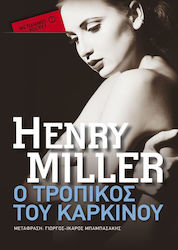
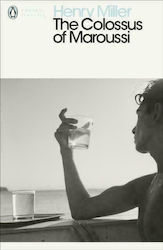
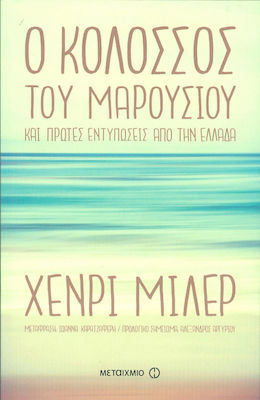
While in Paris, he wrote about his bohemian experiences in "Tropic of Cancer" (1934), about which he said: "This is not a book, in the usual sense of the word. No, this is a prolonged insult, a spit in the face of art, a kick in the pants to God, man, destiny, time, love, beauty... whatever you please. I will sing for you, perhaps a little off-key, but I will sing." The book was immediately banned in the U.S. for its obscenity and graphic erotic content. In 1964, the Supreme Court finally ruled that "Tropic of Cancer" could no longer be banned. By then, it had already sold two million copies. Meanwhile, the triangular relationship between Miller, June, and Nin served as the basis for several of Nin's diaries and the film "Henry and June" (1990). When the English writer George Orwell traveled to Spain as a correspondent for the Spanish Civil War, he stopped in Paris and met Miller, who told him he was a pacifist. The author's most significant works during this period include "Black Spring" (1936), based on his childhood experiences in Brooklyn, and "The Colossus of Maroussi" (1941), inspired by a trip he took to Greece in 1939. In 1942, he moved to California, eventually settling in Big Sur, on the coast. "It is my belief that the inexperienced artist rarely creates in idyllic landscapes," Miller wrote in "Big Sur and the Oranges of Hieronymus Bosch" (1957). "If an art colony is established here, it will end up like all the others. Artists never create in colonies. Ants do. What the budding artist needs is the privilege of struggling with his problems alone—and occasionally a piece of red meat." In 1944, Miller married Janina Martha Lepska, a young philosophy student more than 30 years his junior. Their marriage dissolved seven years later, but Miller soon found a new partner, Eve McClure, an artist whom he married in 1953. Henry Miller passed away in Pacific Palisades on June 7, 1980.


 Non-Greek Fiction Books
 Greek Fiction Books
 Greek Fiction Books