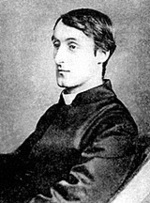
Gerard Manley Hopkins
Gerard Manley Hopkins was born in Stratford, Essex, in 1844. He studied classical literature at Balliol College, Oxford. In 1866, he converted to Catholicism. Two years later, he became a Jesuit and was ordained as a priest in 1877. In 1884, he became a professor of Ancient Greek at the University of Dublin, where he passed away in 1889.
His poems were not published during his lifetime and were known only to a circle of close friends, including the renowned English poet Robert Bridges. Hopkins's poetry was so distinct from the Victorian style that Bridges brought it to light 30 years later, even apologizing for its potential eccentricity. Since then, the fame and influence of Hopkins's work have continued to grow. His work is marked by ecstasy and fervor. For Hopkins, the world is "charged with the grandeur of God," which his poetry seeks to convey. It is a hymn to God, yet, at its best moments, it is also poetry filled with human spiritual anguish.
Hopkins also utilized all the rhythmic innovations of English prosody. Striving to break free from syllabic rules as much as possible, he created his own tonal rhythm, known in the history of English literature as "sprung rhythm." Alliteration and compound words, so beloved and rich in Greek poetry, found in English their worthy expression through him.