Georgios Souris
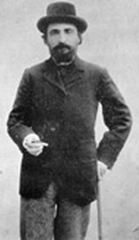
Georgios Souris
Georgios Souris (1853-1919). Georgios Souris was born in Syros, with his father's family hailing from Kythira and his mother's from Chios. His family aspired for Georgios to study theology, but their financial situation did not allow it. He attended primary school in his hometown and high school in Athens until 1870, when he graduated and went to Taganrog, Russia, for three months to work as a clerk for a grain merchant. Upon returning to Greece, he turned to the theater, participating in amateur theater productions (at the age of fifteen, he had participated in a tragedy performance at the Herodes Atticus Theater). His involvement in literature began around 1872 when he published poems in the magazine Fos. In 1873, he published the poetry collection "Collection of Lyrical Songs" and the comedy "From Groom to Best Man," while a milestone in his career was the publication of his satirical poetry collection "My Songs," which was awarded at the Voutsinaio competition in 1876. In 1879, he began studying at the Faculty of Philosophy in Athens, from which he did not manage to graduate, while simultaneously writing articles for magazines and newspapers (Aristophanes, Rambagas, Archilochus). In 1881, he married Maria Konstantinidou. Their home at 15 Pinakoton Street (now Charilaou Trikoupi) was one of the most renowned literary salons in Athens. He continued to publish and release poems until 1902, among which his satirical compositions "Fasoulis the Philosopher" and "Don Juan," part of his six-volume poetry collection "Poems" (1882-1902), are noteworthy. However, Souris' most famous work is the publication of the weekly satirical magazine "O Romios," which first circulated on April 2, 1883, and lasted with two temporary interruptions until November 17, 1918. Souris wrote almost exclusively for "O Romios" (except for some articles by Dimitrios Kokkos in the early issues). His satirical articles targeted everyone, including powerful social and political figures. Indicative is the prosecution he faced in 1897 due to his satirical verses about Queen Olga. In 1886, he was decorated by Charilaos Trikoupis, and in 1906, he was nominated by the Hellenic Parliament for the Nobel Prize in Literature. In 1915, he was honored with the Royal Medal of Letters and Arts. He also continued his involvement in theater, writing verse plays, some of which (such as "Emancipation," "The Periphery," and "He Lacks the Qualifications") were successfully staged, and he produced a verse translation of Aristophanes' comedy "The Clouds," which was performed at the Municipal Theater of Athens in 1900 and in Egypt in 1901 under his direction. His extensive body of work also includes articles and publications in the "Diaries of Romios." Georgios Souris was very popular with the general public due to the witty and humorous content of his writings and his language, which was a mix of the vernacular and forms of the katharevousa. Critics, both contemporary and later, were divided between skeptics (such as Palamas and Psycharis) and supporters (such as Xenopoulos and Markos Avgeris). The information was sourced from the publications of Valetas G.M., "Souris Georgios," Great Greek Encyclopedia 22. Athens, Pyrsos, 1933, Gialourakis Manolis, "Souris Georgios", Great Encyclopedia of Modern Greek Literature 12. Athens, Hari Patsi, n.d., Meraklis M.G., "Georgios Souris", Greek Poetry; Romantics - Era of Palamas - Post-Palamas; Anthology - Literary History, pp. 406-409. Athens, Sokolis, 1977 and Solomou Aliki "Souris Georgios", World Biographical Dictionary 9a. Athens, Ekdotiki Athinon, 1988. (Source: Archive of Greek Writers, EKEBI).
 Greek Fiction Books
Κάποτε σ' Έκλαιε Λαός, Small Anthology of Great Absence
Collective Work, 2020 , manifesto
from18,87 € at 4 stores0