Christopher Woodhouse
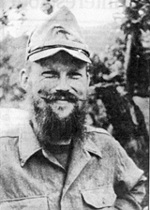
Christopher Woodhouse
Christopher Montague Woodhouse, known as "Monty," was born in 1917 in London to an aristocratic family (Lord Terrington). He was one of the greatest modern philhellenes and historians, specializing in modern Greek history. He studied Classics at New College, Oxford, and in 1939 joined the Royal Artillery. The outbreak of World War II found him in Greece: in 1941, as a reserve second lieutenant of the artillery at the age of 23, and within three years, as a colonel, he became the head of the Allied Military Mission. Tall, blond, with blue eyes, and an imposing presence, he spoke Greek very well, and when locals asked him, "Where are you from, my child?" he would reply, "From a very distant village." The blowing up of the Gorgopotamos Bridge on November 25, 1942, was a pivotal act of resistance during the German Occupation. It resulted from the collaboration of the two largest resistance organizations, ELAS and EDES, under the guidance of British commandos led by Colonel Eddie Myers and Christopher Woodhouse. In 1945, he married Lady Davina, daughter of the Earl of Lytton. Together they had three children. After the war, he served at the British Embassy in Athens until 1946 and then returned to Britain. His subsequent steps are shrouded in mystery. He became involved in espionage, and from 1951 to 1952, he worked at the British Embassy in Tehran. In 1959, he was elected a member of the House of Lords of the British Parliament with the Conservative Party (Harold Macmillan's government) for the Oxford constituency until 1966 and again from 1970 to 1974. During the dictatorship of the colonels, he fought for its overthrow through lectures and articles. A prolific intellectual, he truly loved Greece and dedicated his writing to its history. His rich body of work includes the books "Philhellenes," "In the Struggle for Greek Independence" (Minos, 2020), "The Apple of Discord," a book about the turbulent decade of 1940-1950 (Minos, 2021), as well as the biography of Konstantinos Karamanlis, published in 1982. His comprehensive history of Greece has been translated into Greek, titled "The History of a Nation: The Greeks from 324 to the Present," published by Touriki Editions. In recognition of his contributions to Greece, he was elected a corresponding member of the Academy of Athens in 1980, served as a visiting professor at King’s College London, and was president of the council of the Royal Society of Literature. In 1981, the European Parliament commissioned him to translate from Greek to English the eleven volumes of Panagiotis Kanellopoulos's monumental work "History of European Spirit." The work was completed but not published. He passed away in February 2001. Shortly before his death, he asked his daughter, Emma, to read him Lord Byron's poem "The Isles of Greece."

 Biographies & Memoirs
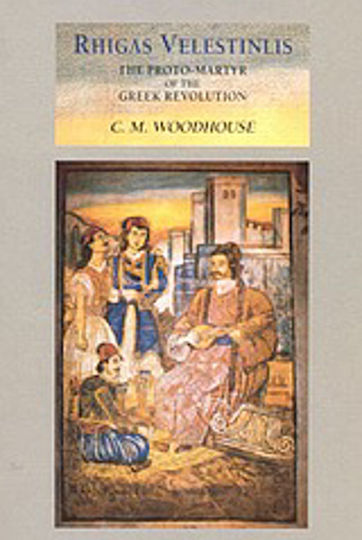
Rhigas Velestinlis, The Proto-Martyr of the Greek Revolution
Christopher Woodhouse, 1995
0

0