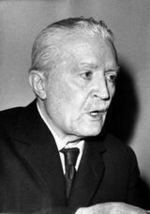
Markos Aygeris
Markos Avgeris (1909-1971). Markos Avgeris, the literary pseudonym of Giorgos N. Papadopoulos, was born in Karitsa, Epirus, where he spent his childhood. His father was a pharmacist. He completed high school in Ioannina and in 1901 enrolled in the Medical School of the University of Athens, from which he graduated in 1907. He practiced as a doctor in private clinics. In 1912, he was drafted as a reserve doctor, serving a total of six years with interruptions until 1922. In 1927, he was appointed to the Ministry of Education. In 1929, he went to Paris for further training, specializing in occupational hygiene, and later went to Germany to study the social insurance system, which he worked to introduce in Greece upon his return. In 1926, he was appointed as an inspector of occupational hygiene at the Ministry of Labor, a position he was removed from in 1947 for political reasons. Before the declaration of the Metaxas dictatorship, Avgeris had already aligned with the Left and participated in the National Resistance during the German occupation, remaining faithful to his ideology until the end of his life. He spent his final years and passed away in Athens. His first appearance in the literary world was in 1904 in the columns of Noumas, where he published the poem "I Vavo i Tasia." That same year, he published the play "In Front of People," which was performed by the New Stage of Konstantinos Christomanos. He subsequently collaborated with magazines such as Hegiso, Panathinaia, Pan, Oi Neoi, Akritas, and others. His poetic work is divided into two periods: the youthful and the late, with a significant gap from 1908 to 1969, when his collection "Antidroma kai Parallila" was published outside of commerce, considered by literary critics as his most important, with most poems written after 1960. His early work is situated in the realm of idealism and the tradition of Solomonic poetry as utilized by interwar poets in Greece (Sikelianos, Varnalis, Melachrinos, etc.). In his later period, he turned towards modern poetry, renewing his expressive means and orientation while maintaining the core of his poetic vision. Additionally, Avgeris engaged in literary criticism within the framework of Marxist literary theory, and his literary and theatrical translation work is significant. For more biographical details on Markos Avgeris, see Alexandros Argyriou, "Avgeris Markos," in "World Biographical Dictionary," vol. 2, Athens, Ekdotiki Athinon, 1984, and Alexis Ziras, "Avgeris Markos" in "Dictionary of Modern Greek Literature," Athens, Patakis Publishers, 2007.
(Source: Archive of Greek Writers, E.KE.BI.).



 Greek Fiction Books