Arthur Schopenhauer
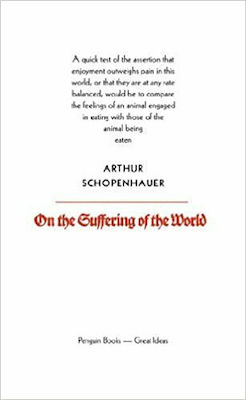
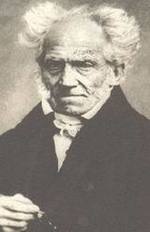
The German philosopher Arthur Schopenhauer was born in February 1788 in Danzig and died in September 1860 in Frankfurt am Main. He was the son of Heinrich Floris Schopenhauer, one of the leading merchants in the area, and Johanna, a well-known novelist. His family was against any form of nationalism, which is why his father chose the name Arthur for his son, a name common in Germany, England, and France. When Danzig was captured by Prussia in 1793, the family moved to Hamburg. There, Arthur studied at a private commercial school to pursue his father's profession. His family traveled frequently, so at a young age, he had already visited many parts of Europe, a habit he maintained into adulthood. However, in 1805, when Heinrich Schopenhauer died after falling into a canal—whether it was an accident or suicide was never known—his mother took Arthur and his younger sister to Weimar, where they became socially connected with the circle of Goethe and Wieland. Goethe even followed Arthur's development, who continued his studies, starting with classical philology, moving on to medicine, and finally philosophy at the Universities of Göttingen and Berlin. There, he was taught by Kantian professors Schulze and Fichte (who described Schopenhauer as a hypochondriac), whose philosophy he later openly despised. In Weimar, he also met the orientalist Friedrich Majer, who introduced him to ancient Indian philosophy, which would deeply influence his philosophical theory. In 1811, he left Weimar and moved to Dresden after a heated argument with his mother (it is said that she never accepted her son's genius), whom he never met again. In Dresden, he wrote his major work "The World as Will and Representation," published in 1819 in Leipzig, but contrary to his expectations, the book was not recognized by critics or the public. Immediately after the book's publication, he returned to Berlin and was appointed a professor. There, his confrontation with Hegel began, who was teaching at the same university at the time. Schopenhauer remained at the university for 24 semesters but only delivered the first lecture, as he ensured that his lecture time coincided with Hegel's, who then dominated philosophical circles. In 1823, he moved to Munich, where he stayed for about a year, sick and isolated. He then returned to Berlin, where his legal troubles began. A seamstress filed a lawsuit against him when, annoyed by her chatter, he pushed her out of the room, causing her to fall down the stairs. Schopenhauer hated noise more than anything else and had written an essay on it, where he notably stated that the eleventh commandment should be "Thou shalt not disturb," especially by making noise, which is the most shameless disturbance, as it not only interrupts you but destroys your thoughts. The decision was in favor of the seamstress, and Schopenhauer was obliged to pay a substantial monthly amount until her death in 1841. On her death certificate, he wrote "Obit anus, abit onus" (the old woman died, the burden is gone). This trial intensified his pessimism and misanthropy, leading him in 1831 to retreat to Frankfurt am Main. Having abandoned the idea of an academic career, he spent the remaining 28 years of his life away from people, with only his dog, Atma, and his housekeeper for company. There, he devoted himself to study and writing, enjoying a rather luxurious lifestyle with food (regular meals despite his doctor's objections), wine, music, theater, and reading mainly French, English, and Italian literature. However, he was not happy. His unfulfilled longing for recognition of his philosophical and literary worth left him restless. He sought recognition but simultaneously scorned and mocked fame and honors. His disappointment and cynicism are channeled into his treatise "On University Philosophy," in which he rebels against academic professors, particularly against Hegelian philosophy and Hegel himself. His pessimism is also evident in his other works, such as "On the Will in Nature," "Aphorisms on Practical Wisdom," and others, which were later included in a collection of essays titled "Parerga and Paralipomena." This publication marked the beginning of his subsequent worldwide recognition. A few years before his death, he saw articles about his works and philosophy published in foreign newspapers and magazines. In 1856, he was honored with the award for the best presentation and critique of ideas from the University of Leipzig, and the following year, his theories became the subject of study at several universities. Today, he is considered one of the most important philosophers of the 19th century and the first great theorist of the pessimistic stance towards life. He was the first to speak of the suffering of existence and attempted to demonstrate the absence of meaning in life and its worthlessness, while still discerning some way out. The only redemption from pain and a meaningless life was art, compassion, meditation, and asceticism, although he himself never wished or managed to master his impulses.




 Greek Fiction Books
 Greek Fiction Books
 Religion & Metaphysics Books