Konstantinos N. Rados
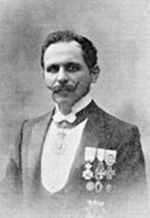
Konstantinos N. Rados (1862-1931). Konstantinos Rados was born in Athens, the son of lawyer Nikolaos K. Rados and grandson of revolutionary Konstantinos Rados. He studied at the Rizareios Ecclesiastical School (1876-1880), law at the University of Athens (graduated in 1885), and history at the University of Athens, Bucharest, and Paris, where he earned his doctorate in 1915. He worked as a Professor of Naval History at the Hellenic Naval Academy (appointed in 1895) and, after completing his doctorate at the University of Sorbonne (1912-1916), as an adjunct professor in the Department of General History at the University of Athens. In 1924, he resigned from both positions to dedicate himself to writing, while also playing a key role in the formation of the Museum of the Historical and Ethnological Society, of which he was a founding member, until the end of his life. He passed away in Athens. During his studies in Athens, he joined the circle of Georgios Mistriotis, advocating for the use of Katharevousa over Demotic Greek, a stance that softened over the years. In Bucharest, he briefly directed the Greek-language newspaper Syllogoi for a month and collaborated with the newspaper Patris, while attending lectures by Professor Epameinondas Fragoudis at the city's university. He made his literary debut with the publication of the short story Didina in the Poikili Stoa almanac in 1895. This was followed by the release of the short story collection Nautical Tales, written in Katharevousa. However, with the short story The Pilot of Dar-Bogaz, published in Konstantinos Skokos' National Almanac in 1912, he turned to Demotic Greek. His literary work is heavily influenced by his historical studies, which constitute a significant portion of his writing. He also conducted the study Stephanos Xenos and the Historical Novel, where he attempted to delineate the relationship between history and 19th-century literature, which was significant for subsequent similar explorations, particularly in the parallel examination of Xenos' work with that of Sir W. Scott. His prose work consists exclusively of short stories, most of which draw their themes from Greek history, especially naval history, while there are also stories with an ethnographic orientation and some with themes from the realm of fairy tales. For more biographical details on Konstantinos Rados, see Evangelidis Tr.E., "Rados Konstantinos," Great Greek Encyclopedia 21. Athens, Pyrsos, 1933, and Kalantzopoulou Viktoria, "Konstantinos N. Rados," Our Older Prose; From its Beginnings to the First World War IX; (1900-1914), pp. 378-402. Athens, Sokolis, 1997. (Source: Archive of Greek Writers, E.KE.VI.).