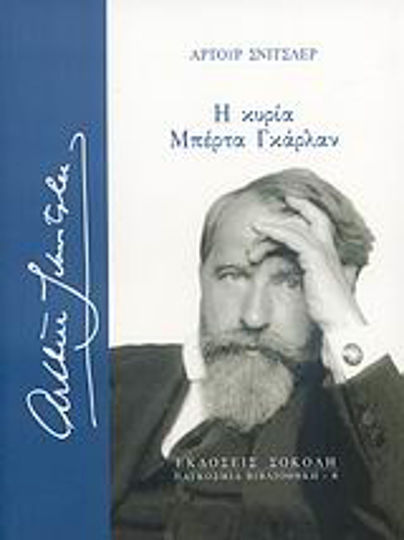
Arthur Schnitzler
Arthur Schnitzler (1862-1931) was born and died in Vienna. The son of a famous Jewish doctor, he studied medicine at the University of Vienna and practiced his profession half-heartedly until 1893, the year of his father's death, when he felt free to devote himself to literature. He had started writing quite early and at the age of twenty-five, he published poems for the first time in "An der schönen blauen Donau," the literary supplement of the magazine "Neue Freie Presse." He became known with "Anatol" (1893), a series of seven one-act plays. This was followed by "Amours" (1895) and the famous "Reigen" (1900), which was adapted into film twice. In 1901, he was removed from the reserve officers' list because of his novella "Leutnant Gustl" ("Lieutenant Gustl"), which was considered to insult the honor of the army. He married in 1903 and divorced in 1921. In 1928, his daughter committed suicide. Schnitzler wrote many plays, which were usually successfully performed on the stages of Vienna and Berlin. However, he also engaged in prose, writing short stories and novellas that are considered even better than his dramatic works: "Lieutenant Gustl" (1900), "Casanova's Homecoming" (1918), "Fräulein Else" (1924), "Dream Story" (1926), as well as two novels, "The Road to the Open" (1908) and "Theresa" (1928). Addressing the fundamental truths of life, Schnitzler characteristically expressed the spirit of his era, the Vienna of the late 19th and early 20th centuries. He gained great recognition, and among his admirers was Sigmund Freud, who, referring to the particular significance of the subconscious in Schnitzler's work, acknowledged that what he had brought to light through painstaking analytical work, the author had discovered through self-introspection. However, his opponents criticized Schnitzler harshly, even labeling him a pornographer. When once remarked that he constantly dealt with the same themes, Schnitzler replied: "I write about love and death. Are there any other themes?"

 Greek Fiction Books
 Greek Fiction Books
 Non-Greek Fiction Books