Dimitrios P. Tagopoulos
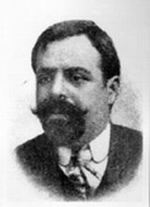
Dimitrios P. Tagopoulos
Dimitris P. Tagopoulos (1867-1926). Dimitris Tagopoulos was born in Hydra, where his father, of Arcadian descent, served as a prefect. His mother hailed from Athens. Both of his parents came from families of fighters from the Greek War of Independence in 1821. He studied at the Medical School of the University of Athens, graduating in 1890, and during his studies, he became friends with Cleanthis Triantafyllou, co-editor of the political and satirical magazine Rambagas (alongside Vlasis Gavriilidis). Through Triantafyllou, Tagopoulos began writing for Rambagas and became connected with the literary and journalistic circles of Athens. He later collaborated with the newspaper Asty and, in 1894, published the satirical newspaper Don Quixote. That same year, he married Aikaterini Kyparissi and settled with her in Sofades, Thessaly, where he lived for four years working as a doctor. With his wife, he had a son, Panos, and a daughter, Myriela. During his time in Thessaly, he ceased his contributions to Athenian publications, except for the Ethnikon Imerologion by K.F. Skokos, where he continued to publish some articles. He returned to Athens in 1899 and then stopped practicing medicine, turning to journalism. He worked as an editor-in-chief for Adonis Kyrou's newspaper Estia (1899-1902), where he also maintained a column titled Phenomena and Things under the pseudonym Noumas. In January 1903, he launched the magazine Noumas, Tagopoulos's platform to critique contemporary social and political realities. Over its thirty years of circulation, it became a symbol of the Demotic Greek language movement in Athens. Tagopoulos initially used a mixed language style. The transformation of Noumas into a publication advocating for the Demotic Greek language was influenced by external supporters, particularly Alexandros Pallis and Dimitris Petrochinos, who provided financial backing, leading Tagopoulos to financial dependency and alignment with the Psycharis orientation imposed. Noteworthy is Tagopoulos's effort to ensure the uninterrupted publication of Noumas from 1903 to 1917 and the collaboration with prominent figures such as Kostis Palamas, Konstantinos Chatzopoulos, Nikos Kazantzakis, Rigas Golgis, Kostas Paroritis, Argyres Eftaliotis, among others. After its closure in 1917, Noumas was briefly republished by Tagopoulos's son, Panos, from 1922-1924 and 1929-1931. In 1919, while appointed as an employee in the preventive censorship service, he was sentenced to four months in prison for negligence regarding a publication in the newspaper Athenian, which was deemed to reveal details about the activities of the exiled King Constantine abroad. He was released after 28 days in Syngrou Prison with a pardon and was appointed by government decision as a secretary at the School of Fine Arts. He was honored with the Award of Letters and Arts in 1923. He died in Athens, mentally and physically shaken by the death of his daughter in 1924. He made his literary debut in 1890 with the publication of the poetry collection First Verses. The entirety of Tagopoulos's poetic, prose, and theatrical work is dedicated to his social and linguistic advocacy. His military service likely hindered the full development of his literary identity. Initially, he adopted the vernacular language of Psycharis to promote his critical stance towards the social and political institutions of his time. However, he eventually isolated himself within the linguistic realm and embraced the theory of the artist's messianic and idealistic perspective. This led to his alienation from both the Psycharists, who disapproved of the social perspective in his writing, and the more conciliatory proponents of the vernacular, as he remained dogmatic on the issue of linguistic expression. For more biographical details on Dimitrios Tagopoulos, see Tellos Agras, "Tagopoulos Dimitrios P.," Great Greek Encyclopedia 22. Athens, Pyrros, 1933; Meraklis M.G., "Dimitrios Tagopoulos," Greek Poetry: Romantics - Palamas Era - Post-Palamas; Anthology - Literary History, pp. 292-294. Athens, Sokolis, 1977; Stavridi-Patrikiou Rena, "Dimitris P. Tagopoulos," Our Older Prose: From its Beginnings to the First World War IX (1900-1914), pp. 424-448. Athens, Sokolis, 1997; and h.s., "Tagopoulos Dimitrios," World Biographical Dictionary 9b. Athens, Ekdotiki Athinon, 1988. (Source: Archive of Greek Writers, EKEBI).

0

0