Vladimir Mayakovsky
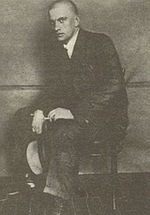
Vladimir Mayakovsky
Vladimir Mayakovsky was born on July 7, 1893, to Russian parents in the village of Bagdati, Georgia, where his father served as a forest and water warden. Vladimir spent his childhood there and attended elementary school, while he pursued his early secondary education in the nearby city of Kutaisi. During those years, he developed an interest in painting and became fascinated with science and technology, which later played a significant role in shaping his futurist poetry. He also became interested in revolutionary ideas. In 1907, after his father's death, he moved with his mother and two sisters to Moscow. There, he continued his secondary education and took painting lessons. In 1908, while still a student, he joined the Bolshevik Party and participated in its illegal activities, which led to two arrests over the next two years. In prison, he read the Bible, history, and literature, and wrote his first poems, although they have not survived. After his release in 1910, he left high school and was admitted to the Moscow School of Painting, Sculpture, and Architecture. There, he met the painter David Burliuk, who would play a significant role in his poetic journey. Mayakovsky and Burliuk joined the emerging Futurist movement in Moscow and participated in the group's first publication, "A Slap in the Face of Public Taste" (1912), where they published and signed the first Futurist manifesto along with Viktor Khlebnikov and Aleksei Kruchyonykh. Mayakovsky first appeared as a poet in the Futurists' joint publication in 1912 with two poems, "Morning" and "Night." In 1913, he wrote the tragedy "Vladimir Mayakovsky," his first synthetic poetic-theatrical work. Between 1914 and 1915, he wrote "A Cloud in Trousers," which was first fully published in 1918, a work the poet described as programmatic for his era. In 1915, he moved to Petrograd, where he became very active. He collaborated with newspapers and magazines, publishing poems that expressed his opposition to the war. He also wrote satirical poems. In 1915, he also wrote one of his most important lyrical poems, "The Backbone Flute." In 1916, he was drafted into the military. That same year, he wrote "War and the World." Mayakovsky's pre-revolutionary period concluded with the poem "Man," another synthetic work with Mayakovsky as the central character. By the time Russia experienced the upheaval of 1917, Mayakovsky was already an accomplished poet who had produced significant work that would secure his place in history. While the war was still ongoing, the country witnessed the bourgeois-democratic February Revolution, which overthrew the Tsar, and the socialist October Revolution of 1917, which aimed to create a new socialist society. The Moscow Futurists were among the first to support the revolution. Mayakovsky became intensely active in many fields simultaneously. He worked as a journalist, created posters, wrote advertising texts, wrote film scripts, and acted in films. In November 1917, he wrote "Our March," his first post-revolutionary poem. In March 1918, the first and only issue of the Futurists' Newspaper was published, in which Mayakovsky published two poems, "Revolution" (a poetic chronicle) and "Our March." He also published an open letter to the workers, in which he largely equated socialism with anarchism and strongly advocated the Futurist stance of rejecting the art of the past. In 1919, on the first anniversary of the revolution, he published the "Ode to Revolution," a poem that was a polemic against the enemies of the revolution and a hymn to labor. In the same year, the play "Mystery-Bouffe" was written and presented in Petrograd, which was characterized as the first communist play. In 1924, following Lenin's death, he completed his major synthetic poem "Vladimir Ilyich Lenin," which he had begun writing in 1923. In 1927, on the occasion of the tenth anniversary of the revolution, Mayakovsky wrote the synthetic poem "Good!" During 1927-1928, Mayakovsky traveled extensively across the Soviet Union, reading excerpts from this poem at special literary evenings. However, no other work of his faced such intense and negative criticism and was so questioned for its sincerity and intentions. In 1928, he wrote the play "The Bedbug" and in 1929 "The Bathhouse," both of which were his last theatrical works. On April 14, 1930, after a period of intense scrutiny and criticism, he ended his life with a bullet to the head. The village where he was born, Bagdadi, has been renamed in his memory. Mayakovsky was one of the revolutionaries of the 20th century.
-
Greek Fiction Books
-

Poetry Books
-

All categories

Categories
0

0
 Greek Fiction Books
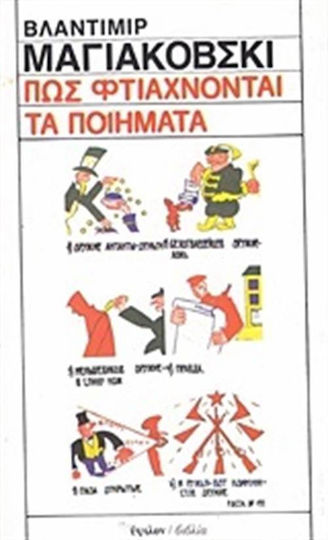
Πώς Φτιάχνονται τα Ποιήματα
Vladimir Mayakovsky, 2015 , Upsilon
from6,75 € at 3 stores0

0
