Pablo Picasso
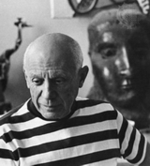
Pablo Picasso
Pablo Picasso (October 25, 1881 - April 8, 1973) is one of the foremost representatives of 20th-century art, co-founder of Cubism alongside Georges Braque, and a significant contributor to the shaping and evolution of modern and contemporary art. His full name was Pablo (or El Pablito) Diego Jose Santiago Francisco de Paula Juan Nepomuceno Crispin Crispiniano de los Remedios Cipriano de la Santisima Trinidad Ruiz Blasco y Picasso Lopez. His father, Jose Ruiz y Blasco, was also a painter, and his mother was Maria Picasso y Lopez. Initially, he signed his works as Ruiz Blasco, but from 1901 onwards, he began using his mother's surname. He was born in Malaga, Spain, where he spent the first ten years of his life. He received his initial painting lessons from his father, who taught at various academic institutions. Picasso himself began painting at a very young age, showing early signs of his talent. In 1892, his family moved to La Coruna, where he lived for the next four years, studying at the local fine arts school. In 1895, his father became a professor at the La Lonja Academy of Fine Arts in Barcelona, where Pablo Picasso also studied, successfully passing the entrance exams. Later, with financial support from his uncle, he had the opportunity to pursue higher studies at the Royal Academy of San Fernando in Madrid, although he abandoned them during the first year. He returned to Barcelona in 1899, where he mingled with the artistic avant-garde of his time, significantly influencing his work. During the same period, he abandoned classicism and began experimenting with new styles. In 1900, he moved to Paris, specifically to Montmartre, a significant center of artistic life. Due to the diversity and temporal span of Picasso's work, it is usually divided into different periods. The main ones are: - Blue Period (1901-1904): Picasso's paintings from this period are characterized by blue hues or shades and symbolize an emotionally charged period in his life. Some of his most famous works belong to this period, depicting acrobats, harlequins, prostitutes, beggars, and artists. The Blue Period includes paintings mainly completed in Paris but are more influenced by Spanish painting. - Rose Period (1905-1907): In the paintings of this period, ceramic colors and earthy tones dominate, often described as more lyrical and cheerful. It is considered the period during which Picasso was most influenced by French painting. - Analytical Cubism (1907-1912): This is the style developed by Picasso himself along with Braque and one of the two main branches of the Cubist movement. - Synthetic Cubism (1912-1915): The period during which Picasso and Braque advanced the Cubist perspective, using the collage technique. The subsequent periods in Picasso's work include a shift to more classical forms and a Mediterranean spirit (1916-1924), his interaction with the Surrealist movement in the mid-1920s, his engagement with sculpture (from the late 1920s), and the work he produced after World War II. He also worked with small ceramic and bronze sculptures and even wrote poems. He identified himself as a poet, saying, "Je suis aussi un poète," which means "I am also a poet." It is believed that through his poems, Picasso more intensely expressed his relationship with surrealism. He began writing them in 1934, and collections of these were later published in the magazines Cahiers d'Art and La Gaceta de Arte. Perhaps Picasso's most famous work is "Guernica" (or "Guernika," as it is sometimes mispronounced in Greek), depicting the German bombing of the Spanish city of Guernica. This large canvas portrays the inhumanity, brutality, and despair of war. The painting process was captured in a series of photographs by Picasso's most famous lover, Dora Maar, a distinguished artist. "Guernica" hung in the Museum of Modern Art in New York for many years, and Picasso had stated that he would not return to Spain until democracy was fully restored. In 1981, "Guernica" was returned to Spain and exhibited at the Cason del Buen Retiro. In 1992, the painting became a major attraction at the Reina Sofia Museum in Madrid. Picasso was exceptionally talented as a painter and designer, even by the standards of the world's greatest artists. He worked equally with oil paintings, watercolors, pastels, charcoal, pencil, and ink. He rendered complex scenes as simple geometric forms in his Cubist works but also created magnificent realistic portraits. His ink and pencil sketches of friends from the Cubist era and beyond are appreciated for their understated intimacy and are examples of his skills. Picasso moved easily within the arts despite his limited academic training (he attended only one year at the Royal Academy of Madrid). His talents were enhanced by a strict sense of duty to his work, which he maintained until the final years of his long life. He died at the age of 92 in 1973.
0
0