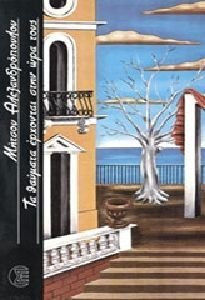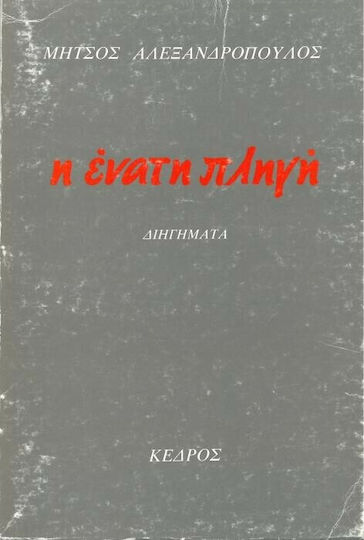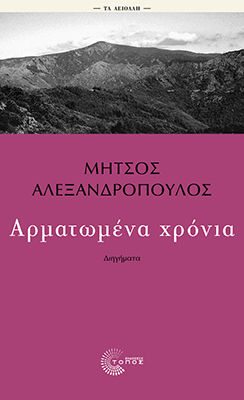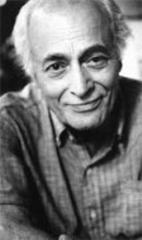
Mitsos Alexandropoulos
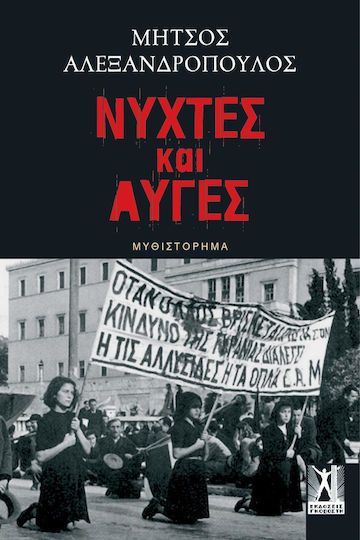
Mitsos Alexandropoulos (1924-2008). Mitsos Alexandropoulos was born in Amaliada. He attended the Law School of the University of Athens. During the German occupation, he participated in the National Resistance, and during the civil war, he sought refuge as a political refugee in Romania and the Soviet Union. From Romania, he made his literary debut by publishing texts in Greek and Russian, joining the circle of Greek writers living in the same country (such as Takis Adamos, Kostas Besis, Elli Alexiou, Apostolos Spilios, among others) and became known in Greece as well. In 1959, Elli Alexiou included Alexandropoulos's short story "The Night of Epiphany" in the anthology of prose from the Greek National Resistance, which she curated on behalf of the Berlin Academy. In the Soviet Union, Alexandropoulos studied at the Moscow Literary Institute and developed an interest in the conservation of religious icons and the study of Russian literature and folklore. There, he married Sonia Ilinskaya, a scholar of Greek literature. Together, they returned to Greece in 1975 and settled in Athens. He was awarded first prize in the resistance short story competition by "Epitheorisi Technis" (1963 for "Koryschades"), the international literary awards Tolstoy (1978) and Gorky (1979) for his studies and translations from Russian literature, the first prize for biographical novel (1981, for "Bread and the Book: Gorky"), the Tumanyan Prize (1985 for "The Armenians: Journey to Their Country and History"), the Pushkin Medal (2007), and the Grand State Prize for Literature for his entire body of work (2001). He passed away in Athens on Monday, May 19, 2008, after battling cancer. Mitsos Alexandropoulos is considered one of the Greek writers of the post-war period. His writing is characterized by poetic realism with elements of political and social reflection, influenced by Russian literature of the second half of the nineteenth century and European writers of the interwar period such as Franz Kafka and James Joyce. A significant part of his work also includes literary translations and biographies of Russian authors such as Fyodor Dostoevsky, Anton Chekhov, Maxim Gorky, Nikolai Gogol, Vladimir Mayakovsky, Osip Mandelstam, among others. Upon his death, the Society of Authors issued a statement referring to him as "the tireless man of letters, who made significant contributions to all genres of prose with short stories, novels, biographies, and for nearly half a century served as a unique bridge between modern Greek and Russian literature...". For more biographical details about Mitsos Alexandropoulos, see Giorgos Kentrotis, "Mitsos Alexandropoulos," in "Post-war Prose; from the War of '40 to the Dictatorship of '67," vol. B, pp. 98-110, Athens, Sokolis, 1988, and h.s., "Alexandropoulos Mitsos," in "World Biographical Dictionary," vol. 1, Athens, Ekdotiki Athinon, 1983.
(Source: Archive of Greek Authors, E.KE.VI.)
 Greek Fiction Books