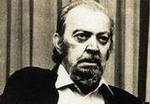
Tasos Leivaditis
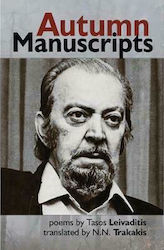
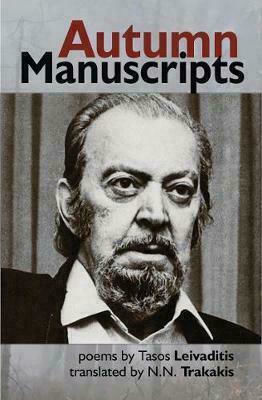
Tasos Leivaditis (1922-1988). Tasos Leivaditis was the son of Lysandros Leivaditis and Vasiliki Kontopoulou. He enrolled in the Law School of the University of Athens, but his studies were interrupted by the German occupation and his subsequent involvement in the Resistance and enlistment in EPON. During the occupation, his financially ruined father passed away, and in 1951, while the poet was exiled to Makronisos, his mother also died. He had four older siblings, one sister, and three brothers. His father was a prominent merchant, and the poet's childhood was happy. He completed high school in Athens. In 1946, he married Maria Stoupa, his childhood friend and lifelong companion, with whom he had a daughter, Vasso. That same year, he made his literary debut with the publication of his poem "The Song of Hatzidimitris" in the magazine Elefthera Grammata. In 1947, he collaborated on the publication of the magazine Themelio. From 1948 to 1952, he was exiled to Moudros, Ai-Stratis, and Makronisos along with other leftist artists and intellectuals, such as Yiannis Ritsos, Aris Alexandrou, Manos Katrakis, and many others, and continued to write poetry. In 1952, his works "Battle at the Edge of the Night" and "This Star is for All of Us" were published. Three years later, he was tried in the Five-Member Court of Appeals for his poetry collection "It Blows at the Crossroads of the World" and was triumphantly acquitted. A milestone in his poetic journey and a symbolic marker of his transition to the second, more introspective and existentially anxious phase of his creation, according to literary theorists, was his book "The Women with Horse Eyes" (1958). In 1961, he participated in concerts by Mikis Theodorakis throughout the Greek countryside, reciting his poems and engaging with the audience. That same year, he collaborated on the screenplay with Kostas Kotzias and wrote the lyrics (music by Theodorakis) for Alekos Alexandrakis' film "Neighborhood the Dream," a landmark in the history of neorealistic Greek cinema, which was banned by censorship. He collaborated with the newspaper Avgi (1954-1980, with a break during the seven-year dictatorship of Papadopoulos) and the magazine Epitheorisi Technis (1962-1966), where he published political and critical essays. During the Papadopoulos dictatorship, he was unemployed and engaged in translations and adaptations of literary works for various popular magazines for livelihood reasons. At the same time, he nostalgically turned to the past, unable to accept the harsh reality of the time, a stance reflected in his poetry of this period, with an emphasis on "The Night Visitor." In 1986, he published his collection "Violets for a Season," considered his swan song. Tasos Leivaditis died in Athens at the General State Hospital from an abdominal aortic aneurysm. After his death, unpublished handwritten poems were released under the title "Autumn Manuscripts." He was honored with the first poetry prize at the World Youth Festival in Warsaw (1953 for his collection "It Blows at the Crossroads of the World"), the first poetry prize of the Municipality of Athens (1957 for his collection "Symphony No. I"), the Second State Poetry Prize (1976 for the collection "Violin for the One-Armed"), and the First State Poetry Prize (1979 for "Euthanasia Manual"). He was a founding member of the Society of Writers. His lyrics have been set to music by Mikis Theodorakis, Manos Loizos, Giorgos Tsangaris, and other Greek composers. The poetry of Tasos Leivaditis is dominated by his poignant existential anxiety, initially expressed as tenderness and compassion within the framework of optimistic socialist realism. In the second phase of his work, this anxiety manifests as an introspective search for the meaning of life in the past, following the disillusionment of expectations and the betrayal of the artist as a fighter for a better world. For more biographical details on Tasos Leivaditis, see Argyriou Alex., "Tasos Leivaditis," in Greek Poetry: The First Post-War Generation, pp. 390-391. Athens, Sokolis, 1982; Kouvaras Giannis, "Chronology of Tasos Leivaditis (1922-1938)," Diavazo 228, 13/12/1989, pp. 20-24; and Tsirimokou Lizy, "Leivaditis Tasos," in the World Biographical Dictionary 5. Athens, Ekdotiki Athinon, 1986. (Source: Archive of Greek Authors, EKEBI).




 Greek Fiction Books