Leonardo Da Vinci
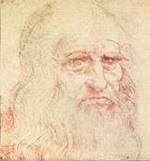
Leonardo Da Vinci
Leonardo da Vinci (April 15, 1452 - May 2, 1519) was an Italian architect, painter, sculptor, musician, inventor, engineer, anatomist, geometer, and scientist who lived during the Renaissance. He is considered the archetypal Renaissance artist, a Homo Universalis, and a genius personality. Among his most famous works are the "Mona Lisa" and "The Last Supper." Leonardo da Vinci was also a significant inventor and scientist, with notable contributions to anatomy and astronomy. He was born in the town of Anchiano, near Vinci, Italy. He was the illegitimate son of Piero da Vinci, a young lawyer, and the peasant woman Caterina. His full name was "Leonardo di ser Piero da Vinci," although he signed his works as "Leonardo" or "Io, Leonardo" ("I, Leonardo"). He grew up with his father in the city of Florence, where from a very young age, he showed signs of intelligence and artistic talent. This was why he was sent at the age of fourteen as an apprentice to the workshop of the Florentine painter and architect Andrea del Verrocchio (1433-1485). In 1472, Leonardo became—according to the custom of the time—a member of the Guild of Painters of Florence, confirming that he was an independent artist. His earliest known work is the so-called "Landscape Drawing of the Arno Valley," which is now housed in the Uffizi Gallery in Florence. Throughout the period of 1472-1480, he worked in Verrocchio's workshop while also creating his own paintings. Later, in 1482, he moved to Milan, where he offered his services as an engineer, painter, and sculptor to the Duke of Milan, Ludovico Sforza. Leonardo had his own workshop with assistants. Around the same time, he worked as a consulting architect for the Milan Cathedral, and between 1495-1498, he painted "The Last Supper" in the monastery of Santa Maria delle Grazie at the request of Ludovico Sforza. As a court artist, Leonardo received several commissions for works, which he often left unfinished. In October 1499, after the defeat of his patron Ludovico Sforza by the French troops, he likely began an ambitious project for Louis XII, King of France. In December of the same year, he left Milan and spent some time in Venice, returning to Florence in 1500, where perhaps the most productive period of his career as a painter began. In June 1502, he traveled with Cesare Borgia in central and upper Italy as an architect and engineer. Among other tasks, he designed maps for Cesare's campaigns. By March of the following year, he was back in Florence, where he began working on his famous painting, the Mona Lisa, commissioned by her husband, Francesco del Giocondo. Shortly thereafter, he started the mural "The Battle of Anghiari" for the council hall of the Palazzo Vecchio, a work that remained unfinished. From 1508 to 1512, he lived almost exclusively in Milan, providing his services to Charles d'Amboise, the city's governor. By this time, Leonardo was a renowned artist, submitting designs for the Trivulzio Monument, continuing his anatomical studies, and undertaking several commissions. After the death of Charles d'Amboise in 1511 and the expulsion of the French from Milan the following year, Leonardo visited Rome under the protection of Pope Leo X's brother, Giuliano de' Medici. In the environment of the papal court, he engaged in various scientific experiments and studies. Beyond his various inventions, he designed the project for draining the marshes of the Pontine region, south of Rome. After the death of Giuliano de' Medici in 1516, he accepted an invitation from the King of France, Francis I, and worked as a painter for the royal court. At the same time, he continued his experiments and was involved in architectural and irrigation projects. On April 23, 1519, he drafted his will and eventually passed away on May 2 in Cloux, France, near the royal Château d'Amboise. According to his personal wish, he was buried in the Church of Saint Florentine in Amboise. His tomb was desecrated during the religious wars, but the church's inscription has been preserved, stating: "In the courtyard of this church was buried Leonardo da Vinci, a nobleman from Milan, engineer and architect of the king, expert in mechanics and formerly the official painter of the Duke of Milan."
0
0
0