Iakovos Kampanellis
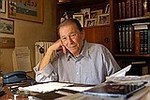
Iakovos Kampanellis
Iakovos Kambanellis, hailed as the progenitor of post-war Greek theater, was born in Naxos in 1922. In 1934, due to financial difficulties, his family moved to Athens, where Kambanellis had to work during the day and attend a night Technical School. Eager for knowledge, he rented books from second-hand bookstores and had acquainted himself with all the European classics by the time he finished high school. In 1942, he was arrested by the Germans and taken to the Mauthausen concentration camp. He was one of the few survivors and returned in 1945. He documented this experience in his unique prose work, "Mauthausen" (1963). Upon returning to Athens, he was captivated by a performance at the Art Theater and decided to pursue theater. He made his theatrical debut in 1950 with the play "Dance on the Wheat" (Lemou Troupe), but he became well-known with his subsequent works, which were staged by the Art Theater of Karolos Koun and the National Theater. A milestone in his career is considered to be "The Courtyard of Miracles" (1957). His work centers on the reflection of social events and their impact on people's lives, particularly the relationship between turbulent modern Greek history and the formation of modern Greek psychology. For his contributions to Greek theater, he has been awarded honorary Doctorates from the Faculty of Philosophy at the University of Cyprus, the Faculty of Fine Arts at the University of Thessaloniki, and the Faculty of Theater Studies at the University of Athens. He was unanimously elected a regular member of the Academy of Athens and has been honored by the President of the Hellenic Republic with the highest distinction. He is a member of the Society of Greek Playwrights. His works have been presented in many countries (England, Austria, Sweden, Romania, Bulgaria, Hungary, Soviet Union, Germany). Some of his performed works include: "Dance on the Wheat" - Lemou Troupe, 1950. "Seventh Day of Creation" - National Theater, Second Stage, 1955-56. The one-act plays "He and His Pants" and "Secret Life" - Vassilis Diamantopoulos, 1957. "The Courtyard of Miracles" - Art Theater, 1957-58. "The Age of Night" - Art Theater, 1958-59. "The Gorilla and the Hortensia" - E. Vergis Troupe, 1959. "A Tale Without a Name" - New Theater Vassilis Diamantopoulos - Marika Alkaiou, 1959-60. "Neighborhood of Angels" - Karezi Troupe, 1963-64. "Viva Aspasia" - Karezi Troupe, 1966-67. "Odysseus, Come Home" - Art Theater, 1966-67. "Colony of the Punished" - Rialdi Experimental Theater, 1970-71. "Aspasia" - Karezi-Kazakou Troupe, 1971-72. "Our Great Circus" - Karezi-Kazakou Troupe, 1973. "The Bean and the Chickpea" - Karezi-Kazakou Troupe, 1974. "The Enemy People" - Karezi-Kazakou Troupe, 1975. "Faces for Violin and Orchestra" - Art Theater 1976-77. "The Four Legs of the Table" - Art Theater 1978-79. "Daddy War" - Art Theater, 1981. "The Invisible Troupe - National Theater, 1988. "The Road Passes Through" - City Experimental Theater, Marietta Rialdi, 1990. "The Dinner", triptych, National Theater, 1993. His work as a screenwriter is also very significant, having had a tremendous influence on his contemporaries and successors. He wrote the scripts for many landmark films of Greek cinema ("Stella" by M. Cacoyannis, "Dragon" by N. Koundouros, "The Abduction of Persephone" by G. He also directed, based on his own screenplay, the film "The Cannon and the Nightingale" in 1968. His remarkable talent in lyric writing is noteworthy, as he penned the lyrics for significant works in Greek music such as "A Tale Without a Name" (music by Manos Hadjidakis), "Mauthausen" (music by Mikis Theodorakis), "Our Great Circus" (music by Stavros Xarchakos), among others. He passed away on March 29, 2011, at the age of 89, after a two-month stay in intensive care.
 Greek Fiction Books
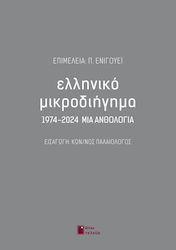
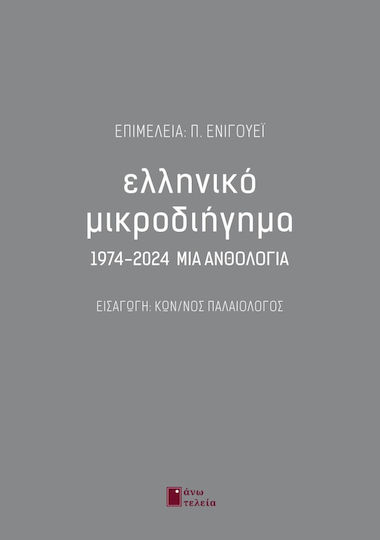
Ελληνικό Μικροδιήγημα 1974-2024 μια Ανθολογία
Giorgos Skampardonis, Sakis Serefas et al., 2025 , Upper Dot Editions
from16,47 € at 6 stores0