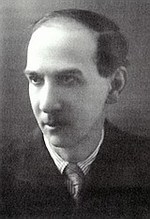
Napoleon Lapathiotis
Napoleon Lapathiotis (1888-1944) was born in Athens, the son of Leonidas Lapathiotis, an officer in the Greek army of Cypriot descent who rose to the rank of general and became Minister of Military Affairs after participating in the Goudi coup, and Vasiliki Papadopoulou, a niece of Charilaos Trikoupis. At the age of ten, he moved with his family to Nafplio, where he completed his schooling, learned English, French, and Italian, and also took piano and painting lessons. In 1905, he enrolled in the Law School of Athens, from which he graduated, though he never practiced law. That same year, at just seventeen, he published the poem "Ecstasy" in "Noumas." In 1907, he was a founding member of the poetry magazine "Hegeso," where he published sixteen poems across its ten issues until 1908, when the magazine ceased publication. He then began his literary and journalistic collaboration with the newspaper "Esperini" and the magazine "Hellas" by S. Potamianos. In the same year, he met K. Christomanos and A. Sikelianos. He later collaborated with the magazines "Daphne" and "Anemone" (1909-1910), the newspaper "Elefthero Vima" (from 1924), the magazine "Diaplasis ton Paidon" (1925), the magazine "Bouquet" (1931), "Nea Estia" (1933 - where he published a significant portion of his literary work), "Pnevmatiki Zoi" (1938), and "Neoellinika Grammata" (1940). In 1917, he participated in the National Defense movement and served as a reserve second lieutenant during the Balkan Wars. After the November events of 1920, he briefly took refuge with his family in Egypt, where he met Cavafy. In 1937, his mother passed away, and three years later, his father's death had a profound impact on the poet's life. The only poetry collection he published was "The First Poems" (1939). Addicted to narcotics, he was forced to sell his library for financial reasons. In 1944, he shot himself at his home in Exarchia. Napoleon Lapathiotis began his engagement with poetry with clear influences from the aestheticism movement (his youthful models were Walter Pater and Oscar Wilde). He published manifestos on aestheticism and sought to react against the stiflingly conservative climate of his time with daring verses and provocative appearances. The sadness that characterized his life led him in his later years to symbolic choices with a distinctly melancholic tone, always maintaining the meticulous form of his poems. He also wrote literary translations and plays ("Nero the Tyrant," [1900], "The Wife's Honor" [1901], "From Midnight to Dawn" [1908]) and engaged in literary essays and musical composition. For more biographical details on Napoleon Lapathiotis, see Giorgos Panagiotou, "Napoleon Lapathiotis and His Era: A Chronological Table," Magazine "I Lexi," issue 33, 3-4/1984, Aliki Paliodimou, "Napoleon Lapathiotis: A Chronobiography," Magazine "Diavazo," issue 95, 30.5.1984, Tasos Korfis, "Napoleon Lapathiotis, Contribution to the Study of His Life and Work," Prospero, Athens, 1985, Katerina Kostiou, "Lapathiotis Napoleon," in "World Biographical Dictionary," vol. 5, Ekdotiki Athinon, Athens, 1986, Napoleon Lapathiotis, "My Life: An Attempt at a Concise Autobiography," ed. Giannis Papakostas, 1st ed. Stigmi, Athens, 1986, 2nd ed. Kedros, Athens, 2009, Takis Spetsiotis, "Hail Napoleon: An Essay on the Art of Napoleon Lapathiotis," Agra, Athens, 1999, Sotiris Trivizas (ed.), "Napoleon Lapathiotis: A Presentation," Gavrielides (series: "Anew"), Athens, 2000, Michalis M. Meraklis, Evdokia Paradeisi, "Lapathiotis Napoleon," in "Dictionary of Modern Greek Literature," Patakis Publications, Athens, 2007, Nikos Sarantakos, afterwords in the collections of short stories "Somewhere a Life Passed," Erato, Athens, 2011, "The Withered Eyes and Other Stories," Erato, Athens, 2011, and "The Mysterious Friend and Other Stories," Erato, Athens, 2013.
(Source: Archive of Greek Authors, EKEBI).
 Greek Fiction Books
 Greek Fiction Books
 Greek Fiction Books
 Non-Greek Fiction Books
 Greek Fiction Books