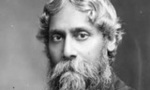
Rabindranath Tagore
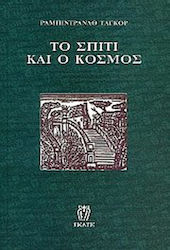
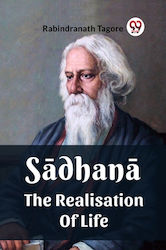
The Indian poet Rabindranath Tagore was born into a prominent family in West Bengal. He was born in 1861 in Calcutta and received his basic education at home in the Bengali language, with English lessons in the afternoons. From a young age, he was familiar with the works of Indian poets who wrote in the same language, and at the age of eight, he composed his first poems. Later, his father, the reformist Hindu Maharishi Debendranath Tagore, sent him to England to study law, where he attended, among other things, the liberal lectures of John Bright and W.E. Gladstone. In 1879, he enrolled at University College London, but the following year he was forced to abandon his studies and return to India at his father's request. In 1883, he married the ten-year-old Bhabatarini, chosen for him by his family, with whom he was to have four children—the first at the age of 13. From 1890, he devoted himself to managing the family estate. During the same period, his first poetry collections were published ("Manasi," 1890, "Chitra," 1895, and "Sonar Tari," 1895), written in simple Bengali rather than the ornate language of literary works. In 1901, he founded the renowned Shantiniketan school near Calcutta, with a group of Hindu and Christian teachers, aiming to "teach the simplicity of life and cultivate beauty." In 1912, his English translation of "Gitanjali," titled "Song Offerings," was published in England with the help of W.B. Yeats. He traveled to Great Britain and the USA for a series of lectures. The following year, in 1913, he was awarded the Nobel Prize in Literature. The prize money was used to improve conditions at the Shantiniketan school. Besides literature, Rabindranath Tagore was involved in painting and music and held exhibitions of his works in the West. Among his students was the renowned Indian film director Satyajit Ray, who was deeply influenced by his teachings. He did not engage in active politics but instead, through his life and work, sought to bridge the gap between East and West. He died in 1941 in Calcutta, after a brief illness, in the same house where he was born. His most notable works include: poetry: "Manasi" (1890), "Sonar Tari" (1894), "Gitanjali" (1910), "Gitimalya" (1914), "Balaka" (1916). In English: "Gitanjali: Song Offerings" (1912), "The Gardener" (1913), "Fruit-Gathering" (1916), and "The Fugitive" (1921). Plays: "Raja" (1910), "Dakghar" (1912), "Achalayatan" (1912), "Muktadhara" (1922), "Raktakaravi" (1926). Short stories and novels: "Gora" (1910), "Ghare-Baire" (1916) ["The Home and the World"], "Yogayog" (1929). His novel "The Home and the World," poems ("Gitanjali," "Mohua," "Lyric Offerings," etc.), collections of short stories ("Indian Stories," "The Stray Birds," etc.), and collections of poetic-philosophical aphorisms ("Fireflies," "The Ocean of Life," etc.) have been translated into Greek.



 Greek Fiction Books
 Greek Fiction Books
 Non-Greek Fiction Books
 Greek Fiction Books
 Kid & Teen Literature