Panagiotis K. Kanellopoulos
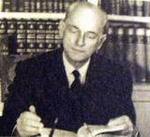
Panagiotis K. Kanellopoulos
Panagiotis K. Kanellopoulos (1902-1986). Panagiotis Kanellopoulos was born in Patras, the son of pharmacist Kanellos Kanellopoulos and Amalia Gounari. He had an older brother, Anastasios, and a younger sister, Maria. He attended the First Gymnasium of Patras and studied at the Law School of the University of Athens (1919-1920), the Law School of the University of Heidelberg (1920-1923, where he earned a Doctorate in Law), and the Faculty of Philosophy at the University of Munich (1923). After completing his studies, he served his military duty and was discharged a year later with the rank of rifleman. He was a member of the Society of Social Sciences (in 1925, following the publication of his first sociological treatise in the Archive of Economic and Social Sciences by D. Kallitsounakis and upon the proposal of the latter, Alexandros Papanastasiou, and Aristotelis Sideris), Secretary General of the Ministry of National Economy in the universal government of Alexandros Zaimis (1926), lecturer (1929), and professor (1933) of Sociology at the University of Athens. In 1929, he participated (alongside Konstantinos Tsatsos and M. Tsamados) in the founding and editing of the journal Archive of Philosophy and Theory of Sciences. In 1935, he married Theano Poulikakou. That same year, he published a series of articles in favor of a republic in the newspaper Akropolis, was dismissed from the university after refusing to swear allegiance to the king, and founded the National Union Party, which advocated overcoming national division and participated in the 1926 elections without success. During the Metaxas dictatorship, he was arrested and exiled to Kythnos, Thasos, and Karystos until 1940. During the Greco-Italian War, he volunteered and served on the front line (Pogradec - Korçë). During the German occupation, he was persecuted for resistance activities and fled to Eritrea in Asia Minor. He served as Vice President and Minister of National Defense in the exiled Tsouderos government, from which he fought for the Greek cause. He participated in the international conference in Lebanon (1944) and was a minister in the national unity government under Georgios Papandreou. During the civil war, he took bold initiatives to prevent massacres. Until 1967, he continued his political activity, holding ministerial and parliamentary positions in many governments, and served as the country's Prime Minister from November 1 to 22, 1945. As the head of the Greek delegation to the UN General Assembly from September to December 1950 and a member of the Academy of Athens since 1959, Panagiotis Kanellopoulos signed the agreement for Greece's accession to the EEC as a representative of the Greek government in July 1961. He was also the leader of the ERE party and, shortly before the imposition of the Papadopoulos dictatorship, formed a government aimed at conducting parliamentary elections. During the dictatorship, he opposed the regime of the colonels. He returned to politics as an independent MP for the New Democracy party in 1977 and 1981 and was recognized as a highly respected figure across party lines. In the field of literature, he is best known for his multi-volume historical work History of European Spirit, and he also engaged in philosophy and sociological and scientific essays. He was honored with the Academy of Athens Literary Prize (1957 for "Born in 1402") and the Goethe Medal (1982), and in 1979 he was elected a foreign member of the Bulgarian Academy of Sciences. He published studies abroad (mainly in Germany), and his works have been translated into English, French, German, and Italian. He passed away at his home in Athens from cardiac arrest. He made his literary debut in 1918 with the publication of a poem in "Noumas." In 1920, he published the poetry collection "Rhythms on the Waves." By 1955, he had published three more collections. In addition to poetry, he engaged in prose writing (publishing the novel "The Redeemed from the Lost Clan" in Munich) and playwriting (with the historical drama "Oliver Cromwell"). For more biographical details on Panagiotis Kanellopoulos, see Despotopoulos K.I., "Kanellopoulos Panagiotis," World Biographical Dictionary 4. Athens, Ekdotiki Athinon, 1985, Hatzifotis I.M., "Kanellopoulos Panagiotis," Great Encyclopedia of Modern Greek Literature 8. Athens, Haris Patsis, n.d., and "Biographical Timeline and Works of Panagiotis Kanellopoulos," Nea Estia 140, Christmas 1996, no.1667, pp.3-11. (Source: Archive of Greek Authors, EKEBI).

 Greek Fiction Books
Η Κριτική για τον Πέτρο Χάρη
Collective Work, 2009 , Kostas and Eleni Ouranis Foundation
0