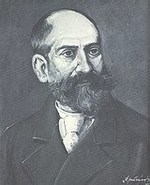
Alexandros Moraitidis
Alexandros Moraitidis (1850-1929). Alexandros Moraitidis was born in Skiathos, the eldest of seven siblings. His father, a cousin of Alexandros Papadiamantis' mother, came from a noble family in Mystras, while his mother hailed from a clerical family in Skiathos. He completed elementary school in Skiathos and graduated from Varvakeio High School in Athens in 1871 at the age of twenty-one. The delay in his education was due to the absence of the third grade of high school in Skiathos, combined with his family's financial difficulties, which forced him to wait before traveling to Athens. A year later, he enrolled in the Faculty of Philosophy at the University of Athens, from which he graduated ten years later (1881). Since 1872, he was a member of the Parnassos Literary Society, where he met publishers Dimitrios Koromilas and Vlasis Gavriilidis. With their help, Moraitidis began his career in journalism. From 1880, he worked as a high school teacher for twenty years. In 1901, he married Vasiliki Foulaki, with whom he decided to live in celibacy. From 1907, Moraitidis abandoned his literary and journalistic activities, and after Vasiliki's death in 1914, he withdrew from worldly affairs to focus solely on writing and translating theological texts until 1919, when he was persuaded by journalist Stefanos Dafnis to publish the first volume of his short stories. In 1914, he was honored with the Award of Letters and Arts. In 1928, he was appointed an honorary member of the Academy of Athens. Shortly before his death, he became a monk and changed his name to Andronikos. He died in 1929. Moraitidis made his literary debut in 1872 with the (considered lost) drama "Michael Komninos, Despot of Epirus," which won an award at the Voutsinaio Poetry Competition. A year later, he presented the translation of the poem "The Lock of Berenice" from Latin (1873). In 1874, he took on the publication of the Greek Parliament's proceedings in the "Newspaper," while simultaneously satirizing political movements in the satirical newspaper "Agora," which he published himself. That same year, he published the play "Vardas Kallergis," followed two years later by "The Destruction of Psara," which won an award at the Nikodimeio Competition, and the historical novel "Demetrios the Besieger." From 1874 to 1881, he published poems, theatrical monologues, and critical articles in "Mi Hanese" and periodicals of the time. In 1875, his comedy "Who is to Blame?" was published in Dimitrios Koromilas' "Athenian Calendar," and in 1876, the comedy "The Two Dominants." He participated in the Lassaneio Dramatic Competition in 1889 and 1896 with the works "The Fall of Constantinople" and "Hamaretos," respectively. From 1880 to 1907, he published short stories and travel impressions in newspapers and magazines, which were released under the titles "Short Stories" and "With the Waves of the North," in two six-volume collections. Moraitidis explored his talents in poetry, prose, theater, translation, and essays. His poetic output is small in volume and includes lyrical and religious poems, written in the demotic Greek (his youthful works) and Katharevousa (those from the more mature period of his life). For the theater, he initially wrote comedies and then moved on to imitate Shakespearean writing. However, in the history of modern Greek literature, Moraitidis is primarily recognized as a short story writer. His short stories belong to the genre of ethnography and are dominated by a spirit of intense religiosity and love for nature. The language used is an elaborate form of Katharevousa, except in the dialogue sections. For more biographical details on Alexandros Moraitidis, see Tellos Agras, "Moraitidis Alexandros," Great Greek Encyclopedia 17. Athens, Pyrsos, 1931 (also in the volume Tellos Agras Critical Volume Three; Forms and Texts of Prose; Edited by Kostas Stergiopoulos, pp. 3004-305. Athens, Hermes, 1984), Alex. Argyriou, "Moraitidis Alexandros," World Biographical Dictionary 7. Athens, Ekdotiki Athinon, 1987, Dimitris Giakos, "Moraitidis Alexandros," Great Encyclopedia of Modern Greek Literature 10. Athens, Haris Patsis, n.d., and Fotis Dimitrakopoulos, "Alexandros Moraitidis," Our Older Prose; From Its Beginnings to the First World War VI (1880-1900), pp. 210-228. Athens, Sokolis, 1997. (Source: Archive of Greek Writers, EKEBI).


 Greek Fiction Books

 Greek Fiction Books