Michael Walzer

Michael Walzer
Michael Walzer was born in 1935 in New York. He studied at Brandeis University and pursued postgraduate studies at the University of Cambridge. He earned his doctorate from Harvard University and taught at Princeton University (1962-1966) and Harvard University (1966-1980). Since 1980, he has been a professor of social sciences at the Institute for Advanced Study at Princeton University. In 2006, he was awarded an honorary doctorate from the University of Athens. Michael Walzer is one of the most prominent figures in American political philosophy. His activities, however, are not confined to academia. He is also involved in journalism and political activism. He is a co-editor of the magazine Dissent, which represents the liberal and social-democratic Left in the United States. He actively participated in the civil rights movement for Black Americans and the anti-Vietnam War movement, and he continues to engage with major political events of our time. He supported the intervention in Afghanistan but condemned the intervention in Iraq, remaining consistently critical of Saddam Hussein's tyrannical regime. Walzer's work primarily focuses on issues of social justice and multiculturalism. Positioned at the intersection of liberalism and communitarianism, he diverged in some respects from the work of John Rawls. Both Rawls and Walzer defend the primacy of the democratic system. Rawls begins with the idea of an "original contract," the subject of which is the selection of principles of justice for the basic structure of society. The contracting parties are free and rational, and, thanks to the veil of ignorance, they stand in a relationship of equality and symmetry with one another. In contrast, Walzer denies the existence of a single principle of justice and argues for the necessity of multiple and diverse principles of justice, which apply to different spheres of social life. Each of these spheres (e.g., economy, politics, entertainment, family, religion) corresponds to a specific good (e.g., money, exile, etc.). Each principle of justice is formulated in relation to the nature of the good being distributed: the need for health, the value for education. A society is just when those who dominate one sphere of social life cannot extend their dominance to an adjacent sphere to acquire its good. For example, those who dominate the market should not be the same as those who control politics. Walzer rejects any idea of overthrowing society through violence and, as a proponent of democratic and decentralized socialism, considers the fundamental problem of democracy to be the method of redistributing goods.

 Political Books
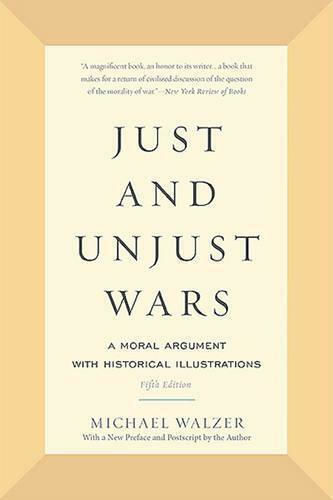
Just and Unjust Wars, A Moral Argument with Historical Illustrations
Michael Walzer, 2015
0

Be the first to leave a comment!