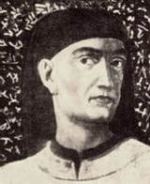
Giovanni Boccaccio
Boccaccio is Italy's greatest storyteller, whose works opened new horizons for European literature. He admired and imitated Dante, devoted himself to Petrarch with a friendship stronger than death, praised his Fiammetta like another Beatrice or Laura, studied ancient and medieval literature, and served as an inspiration for Chaucer and Shakespeare. He wrote remarkable poetry and, most importantly, the first artful Italian novels.
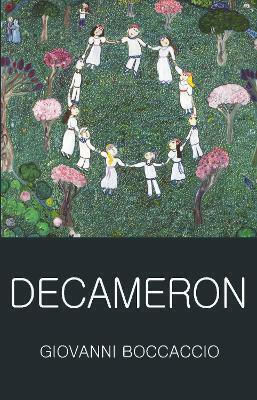
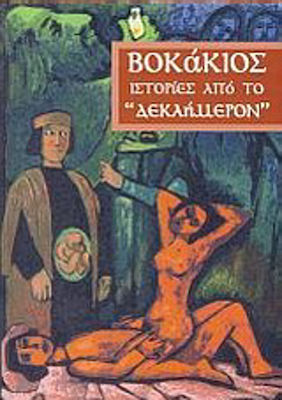
The illegitimate son of the wealthy merchant Boccaccio di Chellino and an unknown woman of humble origin, he was likely born in Florence in 1313. His father acknowledged and adopted him, and in 1327 took him to Naples, driven by ambitious professional plans. However, Boccaccio could not endure the initiation into the secrets of commerce nor the compulsory studies in Canon Law, and in 1334 he began to publish his first works. The great economic crisis that erupted around 1340 forced him to return to Florence. Shortly thereafter, as the Black Death ravaged the city, he met Petrarch (1350) and completed his masterpiece, the "Decameron." He spent the rest of his life devoted to his humanistic studies and writing, traveled frequently, mainly following Petrarch's movements, and passed away, worn out by a long illness, one year after the death of his beloved friend and mentor, in 1375.
 Greek Fiction Books