
Andreas Karantonis
Andreas Karantonis (1910-1982). Andreas Karantonis was born in Andros and moved with his family to Athens at the age of thirteen, where he completed high school and studied at the Law School without graduating. He first appeared in the literary scene in 1927 with the publication of his poems in the supplement of the Great Greek Encyclopedia of Pyrsos. In 1929, he published the study "Introduction to the Work of Palamas." This was followed by a study on Seferis and another on Palamas. Both his poetry and essays up to 1935 adhered to traditional writing frameworks. A turning point in his work occurred around 1935 with his writing activities as the director of the magazine "Nea Grammata." During this period, Karantonis turned towards the surrealist theory of art and translated works by Apollinaire, Valéry, Breton, Éluard, and others. After the German occupation, he developed journalistic activities focusing on his opposition to communism and leftist intellectualism in Greece. In the same spirit, he wrote theater-like texts with titles such as "Study in the Kremlin" and "Karagiozis Comes Out of His Hut." He collaborated with the magazine "Anglo-Hellenic Review" (1945-1952) and from 1949 to 1974, he conducted radio broadcasts of critical content on EIR. He was a permanent member of the committee for awarding state literary prizes, a member of the Group of 12, and the general secretary of the Palamas Foundation. He was honored with the City of Athens Award (1957), the Pourfina Award of the Group of 12 (1959), the First State Criticism Award (1971), and the Grand National Literature Award (1972). Karantonis's critical output was extensive, and he was also involved in literary translation. His poems were collected in eight volumes. For more biographical details on Andreas Karantonis, see Argyrio Al., "Karantonis Andreas," World Biographical Dictionary 4. Athens, Ekdotiki Athinon, 1985, and Chatzifotis I.M., "Karantonis Andreas," Great Encyclopedia of Modern Greek Literature 8. Athens, Hari Patsi, n.d. (Source: Archive of Greek Authors, EKEBI).
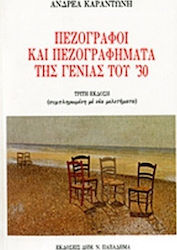


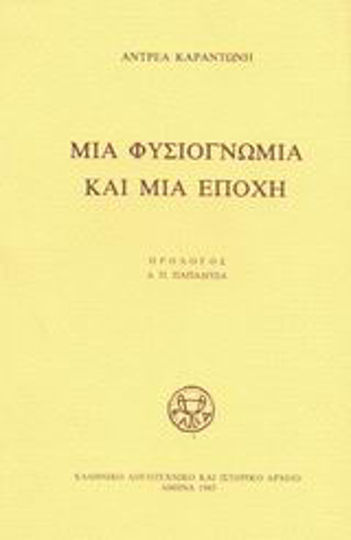 Greek Fiction Books
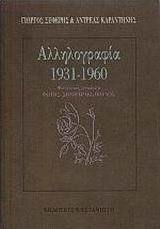 Greek Fiction Books
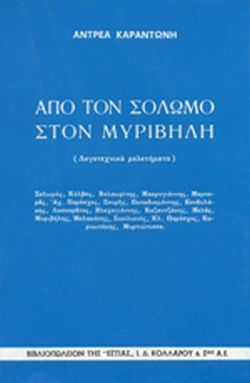 Greek Fiction Books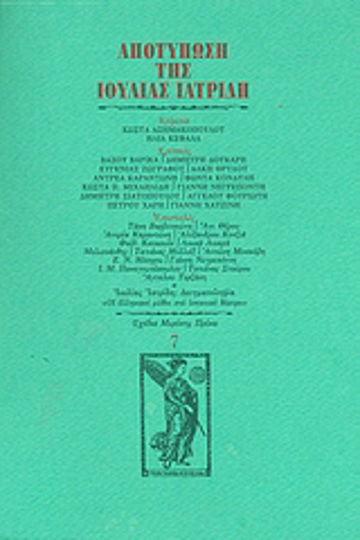
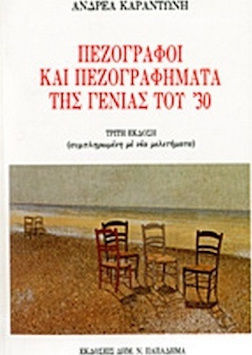 Greek Fiction Books
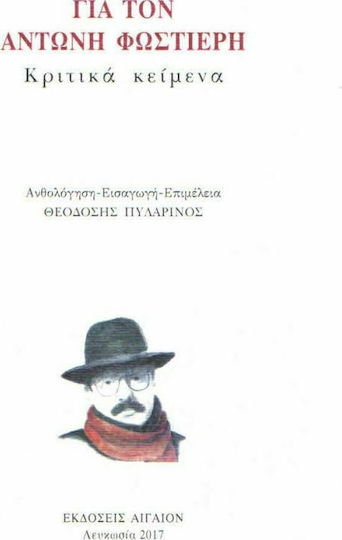 Greek Fiction Books
 Greek Fiction Books