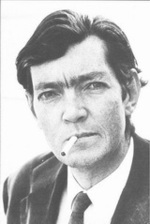
Julio Cortázar
Julio Cortázar was born in Brussels in 1914 and passed away in Paris in 1984. At the age of four, he left Belgium with his family for Argentina, where he completed his schooling, studied literature, and worked as a teacher for five years while also contributing to literary magazines. In 1951, at the age of 37, he returned to Europe, settling in Paris, where he lived until the end of his life and wrote some of his most significant works. "I left Argentina not so much because there were things that bothered me there, which there certainly were, but because France represented, at that time, a huge attraction for me," he said in an interview with "El Pais" in 1982. In 1961, he visited Cuba, fascinated by the revolution, seeking answers to his political concerns. This trip marked the beginning of his clear ideological awareness, leading him to defend the Cuba of Che and Castro and later the Nicaragua of the Sandinistas. In 1970, he visited Chile and attended the inaugural ceremony of Allende's rise to power. A student of Borges, he is considered one of the leading Latin American writers and one of the greatest modernists of the 20th century. His work naturally assimilates the innovative techniques of the contemporary novel and combines creative imagination with realism. However, it differs from the works of other Latin American authors as it almost entirely lacks elements of baroque and magical realism. Among his many significant works are: "Secret Weapons" ("Las armas secretas"), 1958, "The Winners" ("Los Premios" - his first novel), 1960, "Cronopios and Famas" ("Historias de cronopios y de famas"), 1962, "Hopscotch" ("Rayuela" - considered his masterpiece), 1963, "All Fires the Fire" ("Todos los fuegos el fuego"), 1966, "A Manual for Manuel" ("Libro de Manuel" - novel), 1973, "Octahedron" ("Octaedro"), 1974 (all translated into Greek), and "Los Reyes", 1949, "Bestiary", 1951, "End of the Game", 1956, "Around the Day in Eighty Worlds" ("La vuelta al día en ochenta mundos"), 1967, "62: A Model Kit" ("62: Modelo para armar" - continuing the idea of the fragmented novel, as in "Hopscotch"), 1968, "Prose of the Observatory", 1972, "Someone Who Walks By", 1977, "A Certain Lucas", 1979, "Deshoras", 1982, among others.

 Greek Fiction Books