Salvador Dali
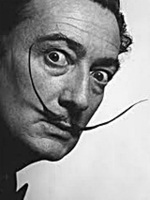
Salvador Dali
Salvador Dalí was born on May 11, 1904, in the small town of Figueras in Catalonia. Dalí spent his childhood in Figueras as well as at the Dalí family's country house near the fishing village of Cadaques, where his parents built his first studio. His childhood and teenage years significantly influenced his later development. Dalí passionately loved the landscapes of his youth, those melancholic landscapes that appear as a direct presence in his paintings. Salvador's relationship with his family was crucial in shaping his artistic personality. His artistic prowess began to take shape at the Academy of Fine Arts in Madrid and under the influence of the Italian Metaphysical School. During this time, Dalí painted his first cubist works. Soon, the Academy seemed too conservative for him. The Impressionist movement and new explorations led him to other realms, where he connected with all the revolutionary creators of the time: Federico García Lorca, Luis Buñuel, Pedro Garcías, Eugenio Montes, and Rafael Barrantes. This initial period, known as the "early period," includes works belonging to various artistic styles: Impressionist, Cubist, academic studies, and realistic works on German Baroque. Surrealist period: (1929-40). In 1929, Dalí was accepted into the Surrealist group led by André Breton. That year, Dalí met Gala Éluard, then the wife of poet Paul Éluard, who became his muse and a source of inspiration embodying everything for him. Soon, Dalí became a leader of the Surrealist movement, which emphasized the importance of the subconscious and the free expression of imagination, as expressed in dreams, free from the control of any logical causality. His work "The Persistence of Memory" remains one of the most famous Surrealist works. However, by the mid-1930s, Dalí's relations with the Surrealists began to deteriorate—even though Dalí participated in the International Surrealist Exhibition in Paris—and by 1939, they were permanently severed. The reasons for this mutual estrangement were that, despite the absolute coincidence of interests in certain areas (the adoption of Freud's views and certain aspects of psychoanalytic theory, as well as the belief in the free play of irrational imagination), there were undoubtedly points of disagreement from the beginning. Dalí always disregarded the political goals of the Surrealists. Additionally, Dalí himself changed significantly during the 1930s, moving towards a new style known as the "classical period." From 1941, Dalí left behind his Surrealist style for a more universal artistic statement. His interest shifted from personal observation to global themes, and he became fascinated by religion and modern science. Dalí turned to Classical and Renaissance art for inspiration, while eagerly anticipating the scientific discoveries coming to light in the 1950s. He wanted to be the representative of the atomic age, to unite the discoveries of modern science with religion and mysticism. During World War II, Dalí and Gala settled in the USA. This period was very significant for the artist. Here, Dalí began painting a series of portraits of social life. In 1941, he wrote his autobiography "The Secret Life of Salvador Dalí." As Dalí distanced himself from surrealism during his classical period, he began painting series of works that included contemporary events, his Spanish heritage, scientific, historical, and religious themes. Among the most famous of these are: "The Geopolitical Child Watching the Birth of the New Man," "The Discovery of America by Christopher Columbus," and "The Hallucinogenic Toreador," which are housed in the Museum of Modern Art in New York. In 1974, Dalí inaugurated the Teatro Museo in Figueras. Exhibitions followed in Paris and London. After the death of his wife Gala in 1982, his health began to decline. "I will return to the concepts of hibernation and reincarnation, which concern me and fill me with a sense of solace," he had written in "The Secret Life" long before. Dalí died on January 23, 1989, after a heart attack.
Related categories
0
0
0