Panagiotis D. Mastrodimitris
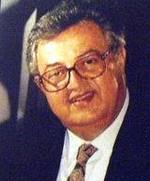
Panagiotis D. Mastrodimitris
P. D. Mastrodimitris was born in Mantoudi, Evia, in 1934. He graduated and earned his doctorate from the Faculty of Philosophy in Athens (1957 and 1970, respectively). He conducted research in Greece and abroad (particularly between 1965-1971, as a scholar of the I.K.T. and the Academy of Athens). Alongside his extensive teaching career, initially in Secondary Education (1961-1968) and later at the University (1966 onwards: 1972-1975 as a professor of Modern Greek Philology in Thessaloniki, and from 1975 onwards in Athens, becoming an emeritus professor in 2001), he produced a rich body of written work (from 1958 onwards). During these years, he was a member of prestigious scientific societies (such as the Society for the Study of the Greek Enlightenment, the Scientific Society of Athens, the Society of Byzantine Studies, the Society of Euboean Studies, the Society of Thessaloniki Writers, the Society of Macedonian Studies, the F.S. "Parnassos", the National Society of Greek Writers, the Board of the "Kostis Palamas Foundation", the Society of Authors [honorary member], the Istituto Siciliano di Studi Bizantini e Neoellenici "Bruno Lavagnini" in Palermo, the Accademia del Mediterraneo in Rome, and the Societe des Etudes Neo-helleniques in Paris). He chaired the Ministry of Culture's literary awards committees (1994, 1997, and 2005 onwards), held key positions in institutions and organizations (I.K.G., "A.S. Onassis" Foundation, etc.), served as director of the Department of Modern Greek Philology and president of the Department of Philology (1983-2001, with brief interruptions), and directed the "Scientific Yearbook" of the School (1979-2003), while supervising and recommending the approval of 28 doctoral dissertations. For his contributions, he was honored with the essay award of the Kostas and Eleni Ouranis Foundation (1989 and 2002), the State Essay-Criticism Award (1992), and the bronze medal of the Society of Euboean Studies (2004). P. D. Mastrodimitris's scholarly work, as reflected in his publications, which fully encompass the content of his university teaching, combines four areas of interest: methodology of philological studies (theoretical issues, research techniques, bibliography, bibliology, etc.), literary history (complex historical-interpretative approach to phenomena and works, comparative perspectives, genre distinctions, etc.), philological criticism (restoration and editing of texts, indexing, interpretation, etc.), and literary criticism (aesthetic analysis and evaluation). These four areas were systematically and combinatorially served with studies published in conference proceedings, tributes, periodicals, and newspapers, as well as in numerous standalone editions (see the relevant listing in the honorary volume "Eukarpias Epanos: Tribute to Professor Panagiotis D. Mastrodimitris", edited by Giorgos Andreomenos, Athens: Poreia, 2007, pp. 55-117). Nonetheless, representative works for each of these could be considered: [1] For the methodology of philological studies: primarily the monumental ("in progress" from 1974 onwards) "Introduction to Modern Greek Philology" (2005), which includes a literary diagram, as well as texts on the life and work of distinguished philologists such as Emmanouil Kriaras, Apostolos Sachinis, Nikolaos V. Tomadakis, Giorgos G. Alisandratos, among others. Regarding literary studies in particular: the research on figures and written documents from the late Byzantine period to the present, starting with the books "Nikolaos Sekoundinos" (1970) and "Greek Scholars" (Vol. A', 1979, 1988) to the more recent "Notarial Documents from Euboea" (2004), always with the author's consistent and permanent concern for integrating each subject of his study into its literary context. In terms of philological criticism: the publication of texts ("The Oath" by Markoras, 1978, new edition 1996, and subsequently the "Poems" by Markoras, 1988; "The Beggar" by Karkavitsas, 1980, new edition 1996; Andreas Karkavitsas, "The Lygery", 1994; excerpts within other studies, etc.), anthologies ("Prologues of Modern Greek Novels", 1974, 1992; "The Poetry of Modern Hellenism", 3 vols., 1991, 2007), works on the language and classical knowledge of Modern Greek authors (see, for example, Reference to the Ancients, 1994), as well as reviews of philological publications. Finally, in literary criticism (always interconnected with philological expertise and consistent interpretation): monographs on creators and achievements of modern Greek poetry and prose, from the three-volume Modern Greek Studies (1975-1988) to other essay collections, including the strictly thematic Palamika (2003), Papadiamantika (2006), Eptanisiaka (2006), etc. What stands out in the entire activity of P. D. Mastrodimitris—research, teaching, and writing—is his enduring interest in establishing Modern Greek Philology as a primary field of university specialization, his decisive contribution to securing Modern Greek Studies at an academic level, and the prestige he brought to the cultivation of the subject he loved and served.
-
Greek Fiction Books
-

All categories

Categories
 Greek Fiction Books
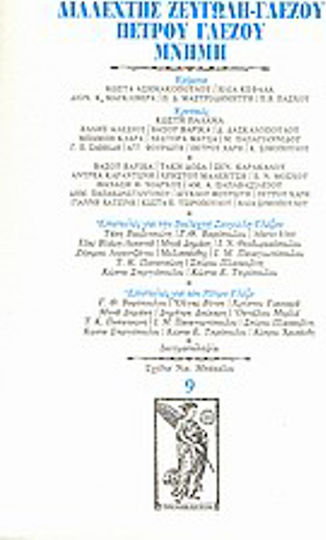
Διαλεχτής Ζευγώλη - Γλέζου, Πέτρου Γλέζου Μνήμη
Collective Work, 2009 , Responsibility
0