Albert Einstein
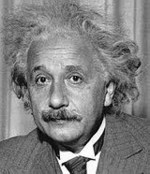
Albert Einstein
Albert Einstein was born in the city of Ulm in southern Germany in 1879 and passed away in Princeton, USA, in 1955. His parents moved to Munich for professional reasons, where his father's brother, an engineer, lived, and soon after to Milan for better career prospects. Young Albert stayed as a boarder at a school in Munich. At the age of 15, he left school, renounced his German citizenship, severed all ties with the Jewish community, and left for Milan to join his parents. After 1-2 years of inactivity, he considered taking the entrance exams for the Zurich Polytechnic as a self-taught student without a high school diploma. This attempt failed, and a professor recommended that he attend high school classes in Aarau. There, he attended the third and fourth grades (for students aged 18 and 19) during the years 1895-1896! Eventually, after completing his school courses, Einstein enrolled in 1896 at the Zurich Polytechnic to study as a teacher for technical vocational schools with a focus on physical sciences. One of his professors, Pernet, soon told him that while he had interest and determination, he lacked the intellect! Assistant Sauter later wrote that student Einstein was solitary, did not follow the teachers' instructions, and threw away the problem-solving instruction leaflets. Additionally, the great mathematician Minkowski, who would later play a decisive role in the mathematical substantiation of the "Theory of Relativity," did not hold the young physics student's knowledge in high regard. After completing his studies, Einstein found a position as an assistant teacher in Winterthur but was soon dismissed due to inadequacy. A friend eventually recommended him to the director of the Swiss Patent Office in Bern. His job was to prepare the patent recognition documents, which required him to describe each invention briefly, understandably, and concisely. The inventors themselves were usually unable to describe their inventions. Here, Einstein's ability to delve into foreign ideas and recognize the essence of a process or mechanism, while simultaneously identifying any errors, was revealed. He later confessed that this job fascinated him and became his hobby, instead of publishing successive uninteresting scientific papers in journals. Yet, at some point in 1905, he published a paper titled "A Hypothesis on the Quanta of Light," extending Planck's discovery from 1900. Formally, Einstein received the Nobel Prize for this work 16 years later. Again in 1905, the "Special Theory of Relativity" was published for the first time. This work established that there is no absolute space and time, but everything depends on the respective observer and is relative to their position and motion. This work made a huge impression on the scientific community! From then on, prominent scientists from around the world began visiting Bern to meet the peculiar public servant. However, Einstein's fame mainly arose from the fact that leading scientists engaged with his work. In 1911, Einstein became a professor at the German University of Prague and later in Berlin, where alongside his teaching duties, he completed the "General Theory of Relativity." This theory was experimentally confirmed by English scientists during World War I by measuring the deflection of starlight as it passed through the gravitational field of massive bodies, such as the sun. In 1933, when the Nazis had already been elected to the German government, they began to slander Einstein as an agent of the Americans and the Anglo-French, disturbed by the fact that the most prominent representative of German science at the time was a Jew. This led to the great researcher being forced to leave the German Academy of Sciences. He also left Germany, this time permanently, heading to America. With Einstein's settlement in Princeton, a new period of his life began. At that time, Bohr's announcement that Hahn and Strassmann had achieved the first nuclear fission in their laboratory in Germany made a significant impact on the scientific community. Researchers immediately began repeating these experiments by bombarding uranium nuclei with neutrons. The result was the release of a tremendous amount of energy, a discovery that led to the construction of the atomic bomb. Einstein was persuaded by his fellow scientists, mainly Teller, to contribute to the effort to build the bomb, fearing that the Nazis would conquer the entire civilized world if they managed to acquire the destructive weapon first. To this end, he sent a letter to President Roosevelt, presenting the potential of the atomic bomb and the dangers posed by its possession. Ultimately, the scientific community's fears of misuse were realized from the opposite side, as the atomic bomb constructed under Oppenheimer's direction was used by the United States against Japan after the effective end of the war. Subsequently, and until the end of his life, Einstein was active in disarmament movements, as the Soviet Union had also become a nuclear power and the "Cold War" had begun. He frequently signed declarations with other scientists, mainly with B. Russell, who was the leading figure in the peace and disarmament movements.
-
Scientific Books
-

Philosophy Books
-
Greek Fiction Books
-

All categories

Categories
 Greek Fiction Books
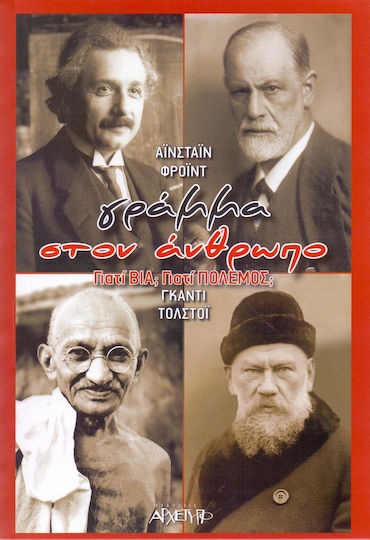
Γράμμα στον Άνθρωπο, Why Violence? why War?
Collective Work, 2014 , Archetype
from8,93 € at 7 stores0
0

0