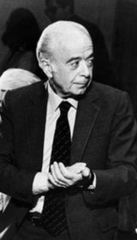
Antonis Samarakis
ANTONIS SAMARAKIS (1919-2003). Antonis Samarakis, son of Euripides and Andriani, was born in Athens, where he studied law (1937-1941). From 1935 to 1963, he worked at the Ministry of Labor, a position he resigned from during the Metaxas dictatorship, returning to it in 1945. He represented Greece in international meetings on labor and migration issues. In 1963, he married Eleni Kourembana. Between 1968 and 1969, he led an expert mission to African countries on behalf of the International Labor Organization. As a UNESCO representative, he traveled to Ethiopia and actively wrote articles to mobilize international support for resolving the country's issues.
Samarakis made his literary debut in the early 1930s as a poet in the magazines "Children's World" and "Diaplasi ton Paidon." He later published in "Nea Estia" and other magazines like "Start" and "Neohellenic Letters." He also collaborated with the magazine "Aktines" after the 1940 war. His first short story collection, "Hope Wanted," was published in 1954, followed by five more books, which saw numerous reprints and translations into foreign languages. He was awarded the State Short Story Prize (1962 for "I Refuse"), the Prize of the Twelve - Kostas Ouranis Award (1966 for "The Flaw"), and the Grand Prize for Detective Literature in France (1970 for "The Flaw"). He was also honored for his overall contribution by the Europalia organization (1982) and with the Knight's Cross of the Order of Arts and Letters (1995).
After the political changeover, he published social and political content in daily and periodical press. His short stories were adapted into film scripts, and "The Flaw" was made into a movie by Peter Fleischmann. Samarakis' prose is characterized by social critique, expressing a deep concern for the direction of the modern world, social consciousness, and a humanitarian worldview. His language is simple, without pretentious style, noted for its density of meaning. His works are particularly interesting for their inventiveness in plot development and endings, and the frequent use of visual elements (typed texts, sketches, etc.). For more biographical details on Antonis Samarakis, see Dimitris Daskalopoulos "Antonis Samarakis," in "Post-War Prose: From the War of '40 to the Dictatorship of '67," Vol. VII, pp. 54-99. Athens, Sokolis, 1988, Alex Ziras, "Samarakis Antonis," "World Biographical Dictionary," 9th edition. Athens, Ekdotiki Athinon, 1988, and Giannis H. Pappas, Antonis D. Skiathas, "Outline of Antonis Samarakis' Work Biography," Eli-trochos 17-18 (Patras), Winter - Spring 1999, pp. 7-13.
Bibliography (first independent editions):
I. Short Stories
"Hope Wanted: Short Stories." Athens, 1954.
"I Refuse." Athens, Fexis, 1961.
"The Passport." 1973.
"The Clash: Short Stories." Athens, 1992.
II. Novels
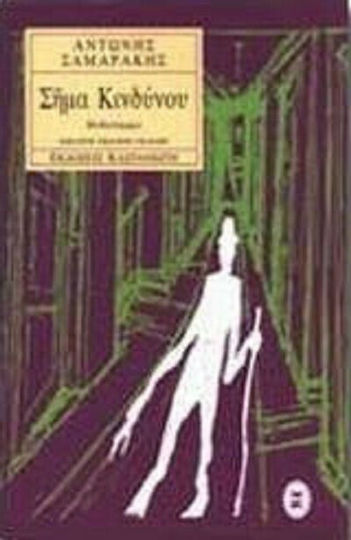
"Alarm Signal: Novel." Athens, 1959.
"The Flaw: Novel." Cover by engraver A. Tassos. Athens, Estia Bookstore, 1965.





 Greek Fiction Books
 Greek Fiction Books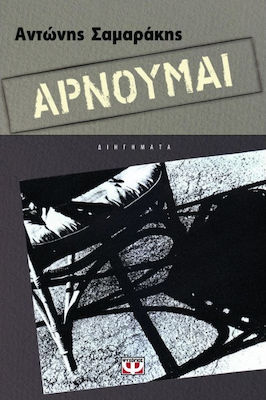
 Greek Fiction Books