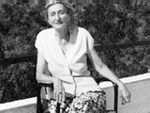
Melpo Axioti
MELPO AXIOTI (1905-1973). Melpo Axioti was born in Athens, the daughter of Mykonian composer and art critic Georgios Axiotis (who also served as president of the Mykonos Community for six months in 1915) and aristocrat Kalliopi Vavari. Her parents divorced in 1908, and Melpo was raised in Mykonos by her father, who remarried the following year to Maroulina Grypari, daughter of politician Ioannis Gryparis, with whom he had two children, Panagos and Frosso. In 1910, her mother married Dimitrios Poseidon. In Mykonos, Melpo grew up without her mother in the strict environment of the Axioti family and completed her schooling there. From 1918 to 1922, she attended the Ursuline School in Tinos as a boarding student. In 1922, she moved to Athens to live with her mother and half-sister Haroula. Her father passed away two years later during a visit to Athens. In 1925, she married her theology teacher Vasilis Markaris and moved to Mykonos with him. Their marriage lasted four years. After their divorce, she returned to Athens and attempted to live with her mother again. However, difficulties in their relationship led to frequent relocations. In 1934, she opened a dressmaking business with Veta Tsitimati, which operated for a year. During this time, and until 1936, Axioti attended design classes at the Sivitanidios School. In 1936, she joined the Communist Party of Greece (KKE), marking her lifelong political commitment to the Left. A year later, she met lawyer Nikos Alexiou, with whom she formed a romantic relationship. Her literary debut came in 1933 with the publication of the short story "From Yesterday to Today" in the magazine Mykoniatika Chronika by Yiannoulis Boni. More publications followed in the same magazine, and in 1938, her first novel, "Difficult Nights," was published and awarded the first prize by the Women's Association of Letters and Arts a year later. During the pre-war period, she became involved with the literary circles of Athens and met notable figures such as Nikos Engonopoulos, Giorgos Theotokas, Nikos Kavvadias, Kleon Paraschos, and Giorgos Seferis. During the German occupation, she joined the National Solidarity of the EAM and collaborated with the underground press alongside Dido Sotiriou, Elli Alexiou, Elli Pappa, Titika Damaskinou, and other Greek women of the resistance. After the liberation, she continued her writing and political activities while collaborating with the magazine Charavgi (1946). The impending consequences of her leftist activities forced her to seek refuge in France in 1947, where she continued her struggle through articles in magazines and participation in conferences, speeches, and other events of the leftist movement there. In France, she met leading figures of the leftist intellectual community, including Louis Aragon, Elsa Triolet, Paul Éluard, André and Alice Bonnard, and Pablo Neruda. From Paris, she began her journey toward pan-European recognition as a writer with the translation of her novel "Twentieth Century," first into French (1949) and subsequently into German, Italian, Russian, and Polish. In 1950, an intervention by the Greek government to the French authorities led to Axioti's departure for East Germany as part of a mass expulsion of 90 individuals. From Dresden, where she lived until the end of the year, she continued her activities, while her works continued to be published and released in European countries. In November 1951, she settled in East Berlin, where she engaged in journalism and literary translation and participated in the World Festival of Youth, during which she met Nazim Hikmet. In 1952, she moved to Warsaw and worked on a Greek radio program there, invited by Lefteris Mavroeidis. She lived in Warsaw until 1955, with an interim visit to Moscow due to the worsening of her chronically fragile health from bronchitis. In 1956, she returned to East Berlin, where she lived until the spring of 1957. That same year, her mother passed away. After a brief return to Warsaw, she went back to Berlin at the end of 1957, and from October 1958 to 1964, she worked as a Visiting Lecturer at Humboldt University, teaching Modern Greek and the History of Modern Greek Literature. During the summers, she visited Italy and continued writing. In December 1964, she visited Greece after four years of strenuous efforts, and in the summer of the following year, she repatriated by decision of then Foreign Minister Ilias Tsirimokos. After settling in Athens, she continued her travels to Italy and France. During the Papadopoulos dictatorship, she faced financial difficulties, receiving help mainly from friends like Nana Kallianessi, Andreas Frangias, and Yiannis Ritsos. In 1971, after a new deterioration in her health and the onset of progressive amnesia and physical debility, she lived at the Lyberi clinic. The following year, she moved to the Maison de repos boarding house, where she passed away. Melpo Axioti's work is situated in the realm of interwar Greek literature. Her experiences from life in Mykonos and her youth spent between the island and Athens played a significant role in shaping her literary identity. As a result, memory and the attempt to reconstruct the past became central themes in her work. Her writing was also influenced by the modernist trends of the Generation of the '30s (particularly the technique of the interior monologue), the surrealist movement, the emergence of the feminist movement in Greece, and her affiliation with the communist party.
The information was drawn from the entries in "Collected Works of Melpo Axioti III," Athens, Kedros, 1980, "Axioti Melpo," World Biographical Dictionary 1, Athens, Ekdotiki Athinon, 1983, Eleni Elegmitou, "Chronology of Melpo Axioti (1905-1980)," Diavazo 311, 12/5/1993, pp. 34-46, and Takis Karvelis, "Melpo Axioti," Interwar Prose; From the First to the Second World War (1914-1939) II, pp. 262-301. Athens, Sokolis, 1992. (Source: Archive of Greek Authors, EKEBI).


 Greek Fiction Books
 Greek Fiction Books
 Greek Fiction Books