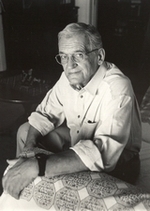
Titos Patrikios (1928). Titos Patrikios was born in Athens, the son of actors Spyros and Lela Patrikios. In 1946, he completed his secondary studies at Varvakeio and enrolled in the Law School of the University of Athens. He worked for several years as a lawyer. During the German occupation, he participated in the National Resistance, initially joining EPON and later ELAS. In 1944, he was sentenced to death by collaborators of the Germans, but his execution was called off at the last moment.
During his military service, he was exiled to Makronisos (1951-1952) and, for the years 1952-1953, to Ai Stratis, from where he returned to Athens with a permit for exiles. From 1959 to 1964, he studied sociology at the Ecole Pratique des Hautes Etudes in Paris and participated in research at the French National Center for Scientific Research. He returned to Greece, but after the imposition of the Papadopoulos dictatorship, he sought refuge again in Paris, where he took part in events against the illegal regime and worked at the headquarters of UNESCO in Paris and at the FAO in Rome.
He returned to Greece in 1975 and worked as a lawyer, sociologist, and literary translator. In 1982, he resumed his position at the National Center for Social Research, which he had held prior to 1967. In Athens, he also worked at the Center for Marxist Studies. His first appearance in the literary world was in 1943 with the publication of a poem in the magazine "Start of Youth," while his first poetry collection, titled "Dirt Road," was published in 1954.
A founding member of the magazine "Art Review" since 1954, he published many articles and reviews in its columns, and many of his essays were included in collected editions. He also engaged in translation (works by Stendhal, Aragon, Mayakovsky, Neruda, Gogol, Garaudy, Lukács, and others) and prose writing, while most of his sociological works are written in French.
His works have been translated into French, Flemish, German, and Dutch. In 1994, he was honored with a special state award for his entire body of work. In February 2020, he was awarded the insignia of Officer of the Order of Arts and Letters by the French Ambassador to Greece, Patrick Maisonnave.
In December 2025, he was awarded the Dido Sotiriou Prize.
 Greek Fiction Books
 Greek Fiction Books
 Greek Fiction Books