Pythagoras
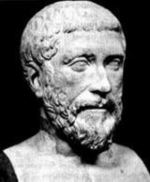
Pythagoras
Pythagoras (570 - 500 BC). Various legends have survived about the life of the great mathematician and philosopher of ancient Greece. His place of origin, Samos, seems to be certain. It is said that he was acquainted with Anaximander and Pherecydes and that he traveled to Egypt and Babylonia. Opposed to the tyrannical regime of Polycrates, he left his homeland around 532/531 BC and settled in southern Italy, in Croton. There, he founded a type of community with ethical-religious, political, and scientific purposes. The teaching was conducted in a mystical and symbolic manner, always based on numbers and their relationships. The students, who regarded Pythagoras as a complete sage and already treated him as a terrestrial god, an incarnation of Apollo, had to remain silent, only listen to the teachings, and maintain secrecy about what happened at the school. For five years, the students remained silent and only listened to Pythagoras' lectures without ever seeing him. Upon successful completion of this trial, the students became members of his household and were allowed to look at him. Pythagoras is the first to call himself a "philosopher" and the first to identify harmonic musical intervals with the help of a string. For this reason, every structured consideration of the history of music begins with Pythagoras and his studies on harmony. For the Pythagoreans, the essence of things lies in numbers and mathematical relationships. Also known is the Pythagorean teaching of "imitation," according to which the sensory world exists as an imperfect imitation of the perfect intelligible world. This introduces into Greek philosophy the concept of two worlds, intelligible and sensory, which subsequently influenced, among others, Plato's theory of the world of ideas. The true source of wisdom for the Pythagoreans is the tetractys, that is, the first four natural numbers, which are considered to be interconnected by various relationships. Indeed, from these four numbers, it is possible to construct the ratios of the fourth, fifth, and octave harmonics. These ratios create harmony (the perception of beauty), which for the Pythagoreans had not just general significance but literally cosmic importance. Pythagoras' teachings seem to have had a significant impact on the development of sciences and philosophy in the ancient Greek world, but there is no clear picture of their exact content (soul transmigration, teachings on harmony and rhythm, etc.). Mainly due to the prevailing secrecy, no written texts by him or his students have been found. Only a few of those attributed to Pythagoras are confirmed by historical evidence. His name has remained eternal due to the eponymous geometric theorem attributed to him by Euclid. Although there is evidence that this theorem was already known to pre-Greek mathematicians, Pythagoras seems to have introduced and used it in the Greek world. According to Diogenes Laertius, Pythagoras was killed while trying to escape from the pursuit of the residents of Croton, who feared the establishment of tyranny due to the great power he and his students had acquired in the city. The Crotonians slaughtered Pythagoras and his 400 students after first burning down the house of Milo, where they had gathered shortly before. Dicaearchus, however, mentions that Pythagoras died in the sanctuary of the Muses in Metapontum, having fasted for forty days.
0