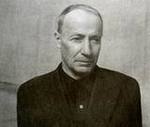
Dimosthenis Voutyras
Demosthenes Voutyras (1872-1958) was born in Constantinople, the son of notary Nikolaos Voutyras and Theoni Papadi. He spent his early childhood there while his father worked as a teacher. A few years later, his family moved to Piraeus, where his father was appointed as a notary. Voutyras completed primary school and began attending high school, but his education was interrupted due to epileptic seizures. This condition led to his parents being overly protective, allowing him to spend his teenage years without deprivation. He took lessons in music and fencing and enrolled in the Machairiadis School, but discontinued all due to his temperament.
In 1900, Voutyras made his debut in the literary world by publishing an article in Katharevousa in the Piraeus magazine Chronographos and another in Gerasimos Vokos' magazine Our Periodical, with whom he maintained a steady collaboration. Around 1902, his father left his job and ventured into construction businesses. Demosthenes initially worked at the ironworks factory his father built. During this period, he published the short story "O Lagas," which received praise from Palamas and Xenopoulos (1903). He continued to publish works in literary magazines, including Panathinaia. Around 1904, he married Betina Fexi, with whom he had two daughters a few years later.
His life dramatically changed after the financial ruin and suicide of his father in 1905. He attempted to continue the family business but failed, leading to its complete bankruptcy. Two years later, he moved with his wife to Koukaki and turned to professional writing, selling short stories to magazines and newspapers of the time. His recognition as a prose writer initially came from the Greek diaspora, specifically from Alexandria. After 1920, he began to gain fame in Athens. His career ascended, and by 1923, when he was honored with the Award of Letters and Arts, ten of his books had already been published. Due to ongoing financial difficulties, he also engaged in writing school textbooks in collaboration with M. Papamichail, but the effort failed as the third-grade reader they completed was abolished by the Pangalos dictatorship. He continued to live by writing and, in 1931, was honored with the Award of the Municipality of Piraeus. A few months before Italy declared war, he celebrated forty years of literary activity at the Bograkou tavern in Kypseli, where he was a regular. During the Occupation, he supported the Resistance. After the Civil War, at the age of 80, he published "Slow Dawn." Until his death, he lived bedridden, poor, and unrecognized by the state authorities (the Academy of Athens rejected his nomination proposal in two consecutive elections). He died in 1954.
Voutyras' prose work, almost exclusively short stories, fits within the framework of social realism and marks the transition from ethnography to urban prose. His permanent theme dominated by the life of marginalized (lumpen) groups in Athens and Piraeus. Having lived close to them, Voutyras described their lives and psyche with intense gloomy colors and a depressive tone, yet also showed a tendency towards utopia. In parallel, he depicted the refusal of these groups to integrate into organized society, a refusal that was also reflected in the anarchic structure of his works, some of which also feature elements of metaphysics and science fiction that function symbolically. For more detailed biographical information on Demos F. Voutyras, see Vera Vasardani, "Demos F. Voutyras," in Our Older Prose; From its Beginnings to the First World War X (1900-1914), pp. 280-322. Athens, Sokolis, 1997, Alex Ziras, "Voutyras Demos F.," World Biographical Dictionary 2. Athens, Ekdotiki Athinon, 1984, G.M. Politarchis, "Voutyras Demos F.," Great Encyclopedia of Modern Greek Literature 4. Athens, Haris Patsis, n.d., and Vasias Tsokopoulos, "Chronicle of the Life of Demos F. Voutyras," Demos F. Voutyras; Complete Works A, pp. 9-50. Athens, Delfini, 1994. (Source: Archive of Greek Authors, EKEBI).

 Greek Fiction Books

 Greek Fiction Books
 Greek Fiction Books
 Greek Fiction Books
 Greek Fiction Books