Kostis Mpastias
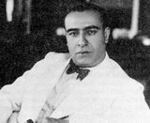
Kostis Mpastias
Kostis Bastias (1901-1972). From a very young age, he was involved in prose, journalism, and theater. For many decades, he was at the center of cultural and political events, exerting his influence as a publisher, editor-in-chief, or columnist for major Athenian newspapers, and as the general director of the National Theatre (1937-1941), the Greek National Opera (1940-41 and 1959-1963), and the National Radio Foundation. His journalistic career began at the Acropolis newspaper of Vlasis Gavriilidis. In 1925, he became editor-in-chief and director of the newspapers Demokratia and Espera, owned by Alexandros Papanastasiou. He also collaborated with Eleftheros Typos of Chr. Kavafakis, Proia of the Pesmazoglou brothers, Estia of the Kyrou brothers, Kathimerini of G. A. Vlachos, and mainly Vradyni of D. Aravantinos from 1936 to 1972. In 1927, he published the combative magazine of the demotic language, Hellenic Letters, which housed the group of Alexandros Delmouzos after the split of the Educational Association. In 1935, he launched the daily independent newspaper Echo of Greece with Herakles Apostolidis, an anthologist of Greek poetry, as editor-in-chief, and in 1964, the weekly news magazine Alpha. In 1923, at just 22 years old, his play Stone of Scandal, about A. Delmouzos and the model girls' school of Volos, was staged by Kyveli. In 1924 and 1925, Marika Kotopouli staged two more of his plays. With the establishment of the National Theatre in 1930, Georgios Papandreou appointed him as general secretary, with Ioannis Gryparis as director and Fotos Politis as director. He left the theater in December 1934, after Politis's death, but returned in October 1935, a week before the overthrow of the P. Tsaldaris government, as a dramaturgy advisor. In 1937, Ioannis Metaxas appointed him as the general director of Letters and Arts at the Ministry of Education and the general director of the National Theatre. During his tenure at the National Theatre, he established the archive drama festivals, promoted his views on presenting ancient tragedies in ancient theaters with performances at the Odeon of Herodes Atticus, and in 1938, for the first time since antiquity, used the ancient theater of Epidaurus to stage Sophocles' Electra, directed by Dim. Rondiris. He created the Royal Theatre of Thessaloniki (1940) and founded the Greek National Opera (1940). He also established the touring theater Thespis' Chariot (1939), the House of Letters and Arts (1937), and inaugurated the institution of state literary awards (1939) and the Panhellenic Art Exhibition at Zappeion (1938). His great dream, the establishment of the National Theatre as one of the most important theaters in Europe, was realized in 1939 with historic tours: Alexandria, Cairo, Oxford, Cambridge, London, Frankfurt, and Berlin. The English newspapers compared the National Theatre to the Comédie Française, Stanislavski's Moscow Art Theatre, and the Habima Theatre. Specifically, The Times of London wrote: "In no country does the theatrical scene owe more to the energy, enthusiasm, and knowledge of one man than the Greek stage owes to Kostis Bastias." From his literary work, we should mention: Lands and Seas (1932), The Fisheries (1935), People and Animals (1939), Ports (1939), Minas the Rebel, awarded by the Academy of Athens (1939), Bouboulina (1944), Spider 44 (1946), Papoulakos (1951), New Sunday School (1956), and the essay Papadiamantis (1962). With the arrival of the Germans in Athens in April 1941, he resigned from the National Theatre. He was arrested and imprisoned for engaging in "pro-British propaganda." After the Occupation, he departed for New York, where he stayed for eight years (1946 - 1954) as a correspondent for Vradini at the United Nations. Upon his return, he resumed the general directorship of the Greek National Opera (1959) and invited Maria Callas to stage the now-historic performances of Norma (1960) and Medea (1961) at Epidaurus. In 1961, he also took on the general directorship of the National Radio Foundation alongside the Opera and oversaw the purchase of the Agia Paraskevi plot and the construction of the radio headquarters. Bibliography: Giannis K. Bastias, Kostis Bastias in the Interwar Years, volumes 2, Athens, 1997. (Source: Archive of Greek Authors, EKEBI).
0
 Greek Fiction Books
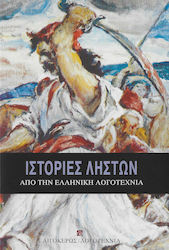
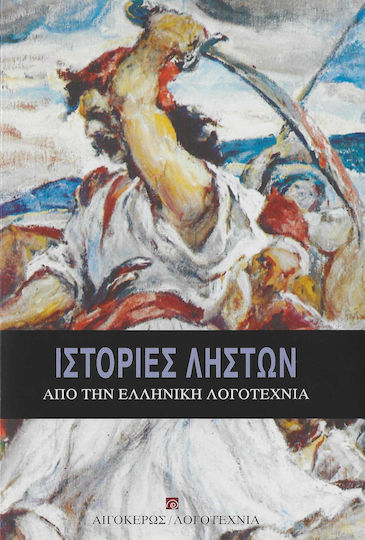
Ιστορίες Ληστών από την Ελληνική Λογοτεχνία
Konstantinos THeotokis, Ilias Venezis et al., 2024 , Capricorn
from11,13 € at 6 stores0

0
 Greek Fiction Books
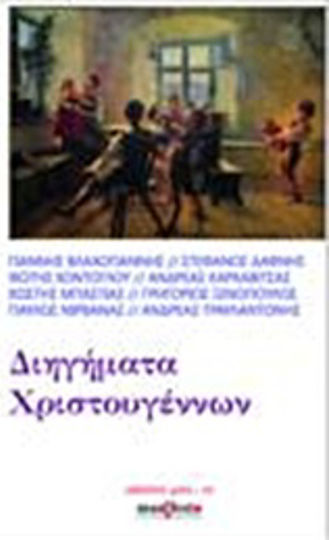
Χριστούγεννα και Χιονιάς, Anthology
Collective Work, 2013 , Cover: Hard , Narcissus
from16,64 € at 2 stores0