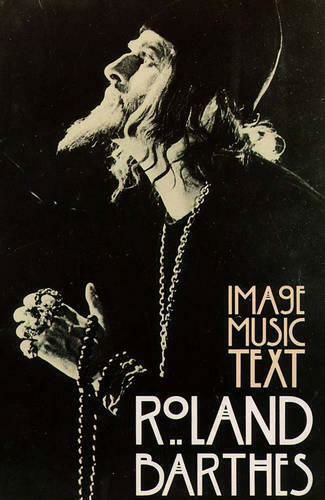
Roland Barthes
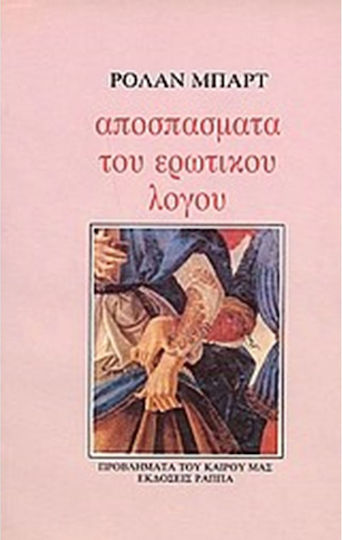
Roland Barthes was born in Bayonne, France, in 1915. In 1924, he moved to Paris, where he attended the Montaigne and Louis-Le-Grand high schools. Between 1935 and 1939, he studied at the Sorbonne, earning a degree in Classical Philology. During his studies from 1936 to 1939, he co-founded the University Group of Ancient Theatre with his fellow students. He spent several years in sanatoriums due to tuberculosis, which he contracted (1934-1935, 1942-1946). He taught briefly at the University of Bucharest and in Egypt (University of Alexandria). He served as a research director at the C.N.R.S. and, from 1962, led a sociology seminar in the Department of Economic and Social Sciences at the Ecole Pratique. Inspired by the linguistics of Saussure and Bloomfield, and later influenced by Lacan's psychoanalysis, his work began with "Writing Degree Zero" (1953), a study of the relationship between literature and power. The idea of a neutral language, detached from the distortions of the social circuit, is present even in his inaugural lecture at the Chair of Semiotics at the Collège de France (1977) and dominates his analysis of the characteristics and myths of modern society ("Mythologies" 1957, "The Fashion System" 1967), the development of the terms of a science of literature ("On Racine" 1963, "Criticism and Truth" 1969), the concepts of the scriptible and the lisible ("S/Z" 1970), the poetics of the free sign ("Empire of Signs" 1970), and the assimilation of a rhetoric of the work with the invention of a complete linguistic idiom and an autonomous universe ("Sade, Fourier, Loyola" 1971, "The Pleasure of the Text" 1973). He reconstructs these acquisitions with references to the body and desire, while "Roland Barthes by Roland Barthes" (1975) constitutes an archaeology of wholehearted dedication to criticism. "A Lover's Discourse: Fragments" (1977) approaches a theory of the conversational, while "Camera Lucida" (1980) seeks, through the study of photography, to define a new relationship between space and time. Roland Barthes, one of the greatest thinkers of our time, met a tragic end in 1980 in a car accident. The evaluation of his work today awards him a distinguished place in the fields of sociological criticism, semiotics, discourse, and, why not, fashion.



 Greek Fiction Books