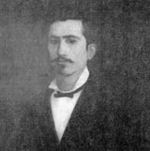
Kostas Krystallis
Kostas Krystallis (1868-1894). Kostas Krystallis was born in Syrrako, Epirus, the son of the affluent merchant Dimitrios Krystallis and his wife Giannoula, née Psalida. He received his early education there, and after the death of his mother, his father's remarriage, and the family's relocation to Ioannina, he continued his studies at the Zosimaia School. In 1887, he published his first poetry collection titled "The Shadows of Hades," whose revolutionary patriotic content endangered his life in then-unredeemed Epirus, forcing him to flee to Athens in 1889. The Turkish military court sentenced him in absentia to twenty-five years of exile. In Athens, he worked as a printer for two years, published the historical epic (as he described it) "The Monk of the Kleisoura of Messolonghi," and wrote the poetry collection "Swallows" and the ethnographic work "By the Spring." Later, he submitted the collection "Rustic Poems" to the Philadelphia poetry competition, which was awarded a commendation. He continued to write and publish poems and narratives in various periodicals of the time and was employed by the magazine "Week," where from 1892, he published his folklore work "The Vlachs of Pindus" in installments. During the same period, he developed an interest in historical research and continued to fight for his homeland's freedom, mainly as a contributor to the newspaper "Voice of Epirus" (1892-1894). He also compiled entries about Epirus for the Encyclopedic Dictionary of Bart and Beck. In 1892, he was again commended in the Philadelphia competition for his collection "The Singer of the Village and the Sheepfold." The preference of the judging committee for Georgios Stratigis for the first prize provoked a reaction from Krystallis and literary circles. At the end of 1893, he won 2,500 drachmas in a lottery, enabling him to publish "Prose Writings" in 1894. During this period, Krystallis worked for the Peloponnese railway company, and despite his deteriorating health, he completed the poem "The Breadwinner," consisting of 259 lines divided into eight chapters, a result of the final editing of his lengthy pastoral idyll "Golfo." His health rapidly declined, and he left for Corfu and then Arta, to his sister's home, where he died at the young age of twenty-six. Krystallis's early poetry collections belong to the romanticism of the First Athenian School and are written in Katharevousa, a result of the influences he received from his contact with the spirit of Athenian romanticism. With his "Rustic Poems" in 1890, he transitioned to the circle of the New Athenian School, turning towards the demotic language and folk song. In prose, his influences are found in the realm of folk traditions. Initially, he used Katharevousa in his prose but soon turned towards the demotic language, in which he is considered a pioneer. Krystallis's premature death deprived us of a more mature creation and a more comprehensive view of his potential. For more biographical details about Kostas Krystallis, see Telos Agras, "Krystallis Kostas," Great Greek Encyclopedia XV. Athens, Pyrros, 1931, Giorgos Aragyis, "Kostas Krystallis," Our Older Prose; From its Beginnings to the First World War VIII (1880-1900), pp. 252-263. Athens, Sokolis, 1997, Alex Argyriou, "Krystallis Kostas," World Biographical Dictionary 5. Athens, Ekdotiki Athinon, 1986, Meraklis M.G., "Kostas Krystallis", Greek Poetry; Romantics - Era of Palamas - Post-Palamas; Anthology - Literary History, pp. 278-282. Athens, Sokolis, 1977, Peranthis Michael, "Krystallis Kostas", Great Encyclopedia of Modern Greek Literature 9. Athens, Hari Patsi, n.d. and "Chronology of Kostas Krystallis", Diavazo 326, 5/1/1994, pp. 38-39.
(Source: Archive of Greek Authors, EKEBI).



 Greek Fiction Books
 Greek Fiction Books