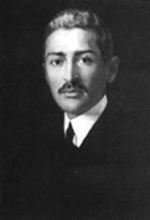
Ion Dragoumis
Ion Dragoumis (1878 - 1920). Ion (Ioannis) Dragoumis was born in Athens, into a family of politicians, and was the son of Stefanos Dragoumis, a freedom fighter, Member of Parliament, Minister of Foreign Affairs in the government of Charilaos Trikoupis, and a scholar. He studied law at the University of Athens and, from 1899, pursued a career in diplomacy, serving in the diplomatic service of the Ministry of Foreign Affairs. In 1897, he voluntarily enlisted on the front of the Greco-Turkish War and was a key collaborator of Pavlos Melas in organizing the defense against the Bulgarians. He fought in the First Balkan War as a simple corporal and, in 1902, was appointed vice-consul at the Consulate of Monastir at his own request. He subsequently served as consul in Serres (1903), Pyrgos, Bulgaria, and Plovdiv (1904), Alexandria and Dedeagatch (1905), and in 1907 was appointed to the embassy in Constantinople. In 1908, he co-founded the Constantinople Organization with Athanasios Souliotis-Nikolaidis, aiming to achieve equality among the ethnicities of the Ottoman Empire and cooperation between Greeks and Turks to create a unified state based on European models. In 1909, he organized the Second Political Department of Eastern Affairs at the Ministry of Foreign Affairs and initially served at the embassies in Rome and then London. After touring embassies and general consulates in the Balkans, he was reassigned to the Ministry of Foreign Affairs, from which he organized the 1911 Dodecanese Congress in Patmos, which was dissolved by the Italians (following the Italian occupation of the Dodecanese). However, he managed to present the demand for union with Greece or autonomy. During the First Balkan War, he served as an advisor to Crown Prince Constantine, witnessed the capture of Thessaloniki, and served at the Ministry of Foreign Affairs under Eleftherios Venizelos, with whom he began to show political differences. During World War I, he served as chargé d'affaires in Vienna and Berlin, where he refused to negotiate the exchange of Greek populations of Thrace and Western Asia Minor with the Turkish populations of Macedonia. He was later appointed to the embassy in Petrograd. In 1915, he resigned from the diplomatic corps and was elected as an independent Member of Parliament for the Florina prefecture. A critic of the royal court for its policy in Macedonia, which led to the surrender of eastern regions to the Bulgarians, he also opposed Venizelos' policy that led to Constantine's exile and criticized the Greek military presence in Asia Minor, a stance that led to his exile, first in Corsica and then in Skopelos. A patriot on the verge of nationalism, Ion Dragoumis was assassinated on Vasilissis Sofias Avenue by Venizelos' bodyguard service (led by Pavlos Gyparis) following the news of an attempt on Venizelos' life in Paris. In the literary field, Dragoumis became known mainly through the Educational Club, which he co-founded, and his collaborations with Dimitrios Tagopoulos' "Noumas" (under the pseudonym Idas). He was also a co-founder of the magazine "Political Review." His literary work includes national-patriotic novels. For more biographical details on Ion Dragoumis, see... Veremis Thanos, "Dragoumis Ion," World Biographical Dictionary 3, Athens, Ekdotiki Athinon, 1985, Koumarianou Aikaterini, "Ion Dragoumis," Our Older Prose from Its Beginnings to the First World War, vol. IA, pp. 8-49. Athens, Sokolis, 1998, Chrysanthopoulos Epam., "Dragoumis Ion," Great Encyclopedia of Modern Greek Literature 6. Athens, Chari Patsi, n.d., O., "Dragoumis Ioannis or Ion," Great Greek Encyclopedia 9. Athens, Pyrsos, 1929, and "Chronography of Ion Dragoumis," Responsibility Notebooks 7, 1978, pp. 147-149.
(Source: Archive of Greek Authors, E.KE.VI.).
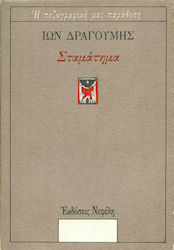


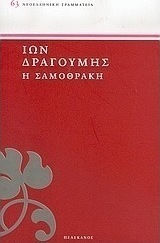
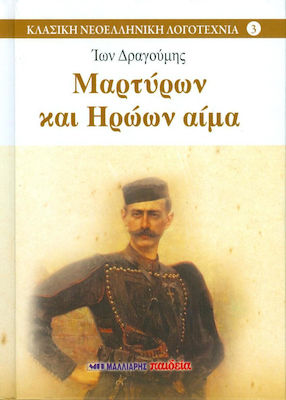 Greek Fiction Books
 Greek Fiction Books