John Mill
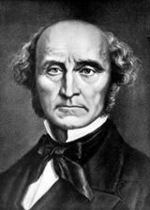
John Mill
John Stuart Mill was born in Pentonville, London, as the eldest son of the Scottish philosopher James Mill (1773-1836). He was educated by his father, with advice and assistance from Jeremy Bentham and Francis Place. He was given an exceptionally strict upbringing and was deliberately shielded from associating with boys his own age. His father, a follower of Bentham, aimed to create a genius intellect that would carry forward the cause of utilitarianism and its implementation after Bentham's death. His accomplishments as a child were extraordinary. At the age of three, he was taught the Greek alphabet and long lists of Greek words with their English equivalents. By the age of eight, he had read Aesop's Fables, Xenophon's Anabasis, and the entire Herodotus, and was familiar with Lucian, Diogenes Laërtius, Isocrates, and six dialogues of Plato. He had also read a lot of history in English and had been taught arithmetic. According to Bain, his autobiography probably underestimates the extent of the work he had accomplished as a child after the age of eight. At eight, he began learning Latin, Euclid, and algebra and was tasked with teaching the younger children of the family. His primary study remained history, but he also studied all the Latin and Greek authors taught at the time in schools and universities. He was not taught to compose in Latin or Greek and was never a true scholar. He learned them for the subject matter he had to study, and by the age of ten, he could read Plato and Demosthenes with ease. His father's "History of India" was published in 1818. Immediately after, around the age of twelve, John began to study scholastic logic thoroughly, simultaneously reading Aristotle's logical treatises in the original language. The following year, he came into contact with political economy and studied Adam Smith and David Ricardo with his father, eventually completing the classical economic view of the factors of production. In 1823, he founded the Westminster Review with Jeremy Bentham as a newspaper for philosophical radicals. However, this intensive study had traumatic effects on Mill's mental health. At the age of 21, he suffered a nervous breakdown. As explained in the fifth chapter of his Autobiography, the breakdown was caused by the great physical and mental strain from his studies, which had suppressed any emotion or intellectual pursuit he would have naturally developed in his childhood. However, the depression eventually subsided as he found solace in the poetry of William Wordsworth and the friendly companionship of Harriet Taylor. His capacity for emotion resurfaced, noting that "the cloud gradually lifted." Mill worked for the British East India Company but was also a liberal Member of Parliament. He advocated for easing the burden on Ireland and primarily worked for what he considered reasonable. In "Considerations on Representative Government," Mill called for various reforms of Parliament and voting, particularly for proportional representation and the extension of suffrage. He was the godfather of Bertrand Russell. In 1851, Mill married Harriet Taylor after 21 years of friendship. Taylor was a significant influence on Mill's work and ideas throughout their friendship and marriage. His relationship with Harriet Taylor inspired Mill's advocacy for women's rights. Mill is considered one of the early feminists. His essay "The Subjection of Women" (1861) is among the first works on the subject of women's rights written by male authors. He was elected as an independent Member of Parliament for Westminster in the 1865 elections, defeating the Liberal General De Lacy Evans. He was defeated in the subsequent 1868 elections by the future minister, Conservative William Smith.
0
0
0