Karen Horney
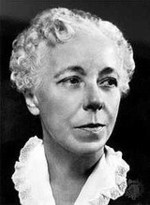
Karen Horney
Karen Horney (1885-1952) was born in Hamburg to a Norwegian father and a German mother and passed away in New York. Her father was a captain, and during her childhood, she traveled extensively with him, visiting many countries in Europe, Central and South America, the Pacific Islands, Japan, and more. In 1909, she married lawyer Oscar Horney in Berlin, from whom she divorced in 1937. She had three daughters, one of whom, Marianne von Eckhardt, is a distinguished psychoanalyst in America. Karen studied medicine at the University of Berlin and graduated in 1913. From 1914 to 1918, she practiced psychiatry and underwent analysis by Karl Abraham and Hanns Sachs during this period. From 1920 to 1932, she taught at the Berlin Psychoanalytic Institute, where many scientists gathered, creating a movement foundational to the history of psychoanalysis, being distant from Freud's direct influence (Vienna). Among them were Abraham, Alexander, Bally, Boss, Fromm, Hartmann, Rado, Sachs, Weigert, and others. Karen Horney distinguished herself early in her scientific career at the Institute, publishing numerous studies, mostly in the International Journal of Psychoanalysis (Internationale Zeitschrift für Psychoanalyse). She participated in many international conferences, including the historic discussion on psychoanalysis by non-psychiatrists, chaired by Freud. In 1932, invited by Franz Alexander, she moved to Chicago, where she served for two years as assistant director of the Chicago Psychoanalytic Institute (with Alexander as director). In 1934, she settled in New York, marking the most creative and fruitful period of her life. She taught at the New York Psychoanalytic Institute (of orthodox Freudian orientation) until 1941, when she founded, with a group of colleagues, the Association for the Advancement of Psychoanalysis and the American Institute for Psychoanalysis, where she served as dean until her death. Simultaneously, she practiced psychoanalysis privately, taught at the Institute and the New School for Social Research, and founded and published the renowned "The American Journal for Psychoanalysis." She also established the "Karen Horney Clinic," aimed at making psychoanalytic therapy accessible to poorer patients. From an early age, her restless and inquisitive spirit was evident. She accepted nothing dogmatically, subjecting the psychoanalytic theories of her time to continuous clinical testing and research. In her first work, "The Technique of Psychoanalytic Therapy," published in 1917, she stated: "Psychoanalysis can free a human being who is tied hand and foot. However, it cannot give them new hands or new feet. Nevertheless, psychoanalysis has shown us that many manifestations, which we considered to have constitutional origins, are simply the result of a blockage in mental development (advancement), which can, however, be removed."
0