Takis K. Papatsonis
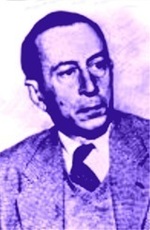
Takis K. Papatsonis
T.K. Papatsónis (1895-1976). Takis Papatsónis was born in Athens, the son of Konstantinos Papatsónis and Aikaterini Prassá. He studied at the French Institute of Athens and published his first poems in the newspaper Akropolis in 1913. He pursued studies in Law and Political Science at the University of Athens until 1920 and attended courses in economic sciences at the University of Geneva in 1927. From 1914, he worked at the Ministry of Finance for forty years, reaching the position of General Secretary. In 1928, he spent several months at Mount Athos. In 1932, he married Evanthia Empedoklis, with whom he had a daughter. Throughout his life, he traveled extensively, both for work and personal passion, visiting places such as Belgrade, Constantinople, Italy, Prague, Switzerland, France, Berlin, Dresden, England, Spain, Bucharest, Bern, the Carpathians, New York, Cuba, Chicago, and San Diego. He served as Vice President of the Board of Directors of the Commercial Bank (1941), President of the Board of Directors of the National Gallery (1953-1964), Vice President of the Board of Directors of the National Theatre (1955-1964), and Vice President and President of the Hellenic Society of Aesthetics (1963 and 1966, respectively). He was honored with the French Knight of the Legion of Honor (1920) and the First State Prize for Poetry (1963). In 1967, he became a member of the Academy of Athens. He passed away in Athens. Papatsónis' first poetry collection was published in 1934 with "Selection A." Prior to this, he had published the first Greek translation of T.S. Eliot's "The Waste Land" in the magazine Kyklos, titled "Eremotopos." From 1935, he collaborated with the newspaper Kathimerini for five years, publishing critical essays. In 1944, he published "Ursa Minor." This was followed by "Selection B" (1962), the travelogue "Exercise in Athos" (1963), the travel text "Moldovlach Myth," studies such as "Friedrich Holderlin, 1970-1843-1970," "National Awakening: Solomos, Kalvos," and essay collections "The Fourfold World" (two volumes) and "Where There Was a Garden." He also engaged in literary translation and collaborated with magazines such as Ellas, Oi Neoi, Logos, Lyra, Mousa, Peitharchia, Protoporia, Rythmos, Nea Grammata, Nea Estia, Elefthera Grammata, Chronika Aesthetikis, among others. Takis Papatsónis is placed by literary historians in the poetic generation of the thirties, as a unique case that transcends categorization. He was one of the introducers of free verse in modern Greek poetry. His poetic work is characterized by creatively assimilated influences and a strongly personal style within the framework of his mystical and theological contemplation. For more biographical details on Takis Papatsónis, see Agra Tellos, "Papatsónis Takis," Great Greek Encyclopedia 19. Athens, Pyrso, 1932; Giakos Dimitris, "Papatsónis Takis," Great Encyclopedia of Modern Greek Literature 11. Athens, Hari Patsi, n.d.; Moundes M., "A Brief Biographical Outline of Takis Papatsónis," Nea Estia 100, year N', 15/11/1976, no. 1185, pp. 1484-1485; Frantzi Antea, "Papatsónis Takis," World Biographical Dictionary 8. Athens, Ekdotiki Athinon, 1988; and Tetradia Efthynis 1. (Source: Archive of Greek Authors, EKEBI).
-
Greek Fiction Books
-

All categories

Categories
 Greek Fiction Books
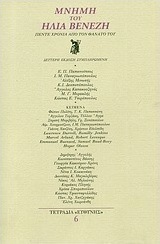
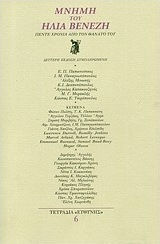
Μνήμη του Ηλία Βενέζη, Five Years Since his Death
Collective Work, 1999 , Responsibility
0
 Greek Fiction Books
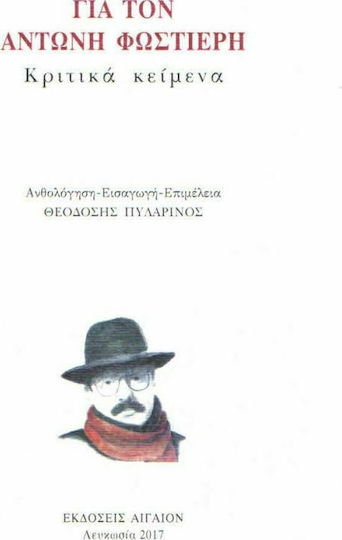
Για τον Αντώνη Φωστιέρη, Critical Texts
Collective Work, 2017 , Aegean Publications
0