Dimitris CHatzis
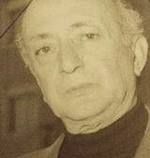
Dimitris CHatzis
Dimitris Chatzis (1913-1981). Dimitris Chatzis was born in Ioannina, the son of Georgios Chatzis, a poet (writing under the pseudonym Pellerin) and publisher of the newspaper "Epirus," and Athina, née Kyriakopoulou, from Aigio. He had six siblings. He attended primary school at the Ionian School in Athens but was forced to discontinue in 1930 after the sudden death of his father and returned to his hometown, where he took over the continuation of the newspaper's publication and the support of his family. There, he completed high school (Zosimaia School) and then enrolled in the Law School of the University of Athens, though he could not complete his studies due to financial reasons. In 1932, he first came into contact with Marxist circles, and in 1935, he joined the Communist Party of Greece (KKE), serving its ideology in Ioannina. A year later, Metaxas' police arrested him, and the dictatorial regime exiled him to Folegandros (he returned in 1937). After the Germans entered the country, he moved to Athens. During the German occupation, he joined the National Liberation Front (EAM) and later became a part of the resistance; he collaborated with the resistance press and then with the newspaper "Eleftheri Ellada," where he remained as editor-in-chief until its closure (1947). In the summer of 1947, he was exiled to Ikaria. After the end of the civil war, he sought refuge as a political refugee initially in Romania and then in Hungary (which became his second homeland; he stayed there for about thirty years and had his first marriage), where he studied Byzantine and post-Byzantine history and literature at the University of Budapest, under Professor Gyula Moravcsik. With the latter's help, he conducted research and a doctoral dissertation on "The Monodies for the Fall of Constantinople to the Turks," with a scholarship at the Academy of Sciences in East Berlin. In 1962, he returned to Budapest, where he worked as an assistant professor in the department of Byzantine philology and founded the Modern Greek Institute, while also publishing scholarly studies in newspapers and magazines and serving as an editor for the publication of translations of modern Greek authors into Hungarian by the Europa publishing house. In 1967, the Papadopoulos dictatorship prohibited his return to Greece. In 1968, he left Hungary, having previously refused Hungarian citizenship, and traveled briefly to Paris, but under pressure from the French police to seek political asylum, he declined the assistant position in the department of Modern Greek Studies offered by the University and returned to Budapest. In 1973, he worked as a professor of Modern Greek literature at the University of Geneva and published a book with Thanasis Chatzis about the dictatorship in Greece, where he returned permanently in the summer of 1975, when the two death sentences for desertion from the civil war era were annulled. In 1975, he taught Modern Greek literature at the School of Mechanical Engineering at the University of Patras with great success; however, due to reactions from conservative circles within the University and the Ministry of Education, the courses were discontinued. From 1975 to 1980, he engaged in intense cultural activities, giving lectures and participating in discussions in schools and universities. During the same period, he collaborated with the magazines "Domi" and "Anti" and published the magazine "Prisma," which released four issues (the last one after his death). In 1979, he married historian Kaiti Chatzi, with whom he had a daughter, Eleni-Angelina. He passed away at a friend's house in Saronida from bronchial cancer. Dimitris Chatzi's first literary efforts date back to around 1930, when he began publishing poems in newspapers in Epirus. In 1947, his novel "The Fire" was published. This was followed by four short story collections and another novel, as well as many of his articles in newspapers and magazines, which remained unpublished. His work is situated within the realm of socialist realism. He is considered one of the innovative realist writers of post-war Greek prose, with a dominant feature of his writing being social concern. Noteworthy is also the often intensely lyrical dimension of his language and the particular attention he paid to his linguistic expression. For more biographical details on Dimitris Chatzi, see Ziras Alex., "Chatzi Dimitris," World Biographical Dictionary 9b. Athens, Ekdotiki Athinon, 1988, "Chronology of Dimitris Chatzi (1913-1981)," Diavazo 180, 12/9/1987, pp. 34-38, and Paganos Giorgos, "Dimitris Chatzi," Post-war Prose: From the War of '40 to the Dictatorship of '67 VIII, pp. 172-249. Athens, Sokolis, 1988. (Source: Archive of Greek Authors, EKEBI).
0
0
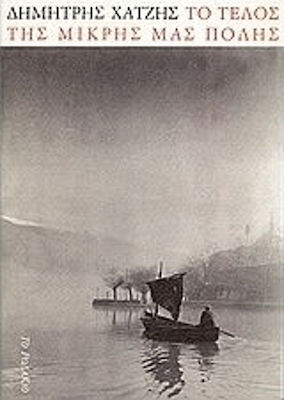 Greek Fiction Books
Το Τέλος της Μικρής μας Πόλης, Short Stories
Dimitris CHatzis, 2007 , Rodakio
from13,78 € at 3 stores0

0
 Greek Fiction Books
Ανθολογία Ελληνικού Διηγήματος του 20ού Αιώνα
Collective Work, 2009 , Cover: Hard , Kastaniotis Editions
from24,86 € at 5 stores0