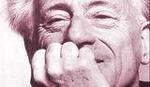
Henri Lefebvre
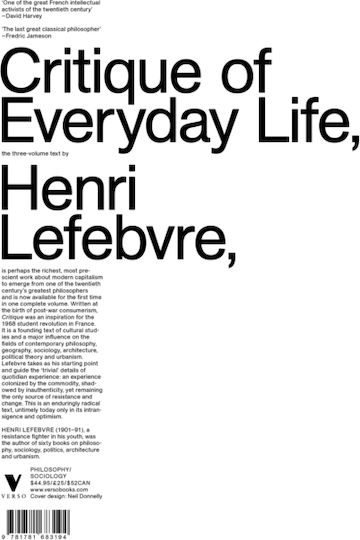
The philosopher and sociologist Henri Lefebvre (1901-1991) was born in Hagetmau, in the Landes region of Southern France. He studied philosophy at the Sorbonne, graduating in 1920. Between 1930 and 1940, he taught philosophy. In 1940, he joined the Resistance, and for a period between 1944-49, he directed the Radiodiffusion Francaise radio station, based in Toulouse. He was closely involved with all the avant-garde movements of the 20th century, starting with surrealism. Around 1928, he was captivated by Marxism and joined the French Communist Party (PCF). His critique of the sociology of everyday life, in his books from the late 1950s, had a decisive influence on the creation of the Situationist movement (Internationale Situationniste). In 1958, he was expelled from the Communist Party, yet he did not renounce Marxism; instead, he sought to restore and revitalize it through the editorial board of the magazine "Arguments" and other interventions. In 1961, he was appointed professor of philosophy in Strasbourg and in 1965 in Paris (Nanterre). He authored numerous works on contemporary society ("Current Problems of Marxism," 1958; Greek edition "Grammata," 1979; "Critique of Everyday Life," 1958-1961; "Language and Society," 1966; "The Right to the City," 1968-1973; Greek edition "Papazisis," 1977, "Koukkida," 2007; "Everyday Life in the Modern World," 1969; Greek edition "Rappas," 1970; "Beyond Structuralism," 1971; "The Production of Space," 1974; "Marxism and the City," Greek edition "Odysseas," 1976, 1983; "Hegel - Marx - Nietzsche, or, The Realm of Shadows," 1975; Greek edition "Rappas," 1976; "The Sociology of Marx"; Greek edition "Gutenberg," 1983, etc.)