Iason Depountis
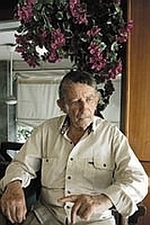
Iason Depountis
Iason Depountis (August 7, 1917 - June 23, 2008). Iason Depountis was born in Corfu. He graduated from the Prosalentis School of Art and moved to Athens, where he attended courses in sociology, pedagogy, psychology, and law. In 1954, he went to Paris for studies in applied psychology, and from 1970 to 1972, he lived in Zurich, where he attended courses in modern mathematics. After 1969, he lived in Switzerland due to the dictatorship of the colonels. Actively participating in turning the funeral of Palamas into an act of resistance against the occupiers (1943), Iason Depountis essentially began his long and arduous journey with poetry from that point on. He first appeared in the literary world through the pages of the magazine "Philological Chronicles" in 1946, with the collection "The Exile of the Immortals." Two years later, his first poetry collection, titled "From the Sea," was published. Subsequently, he published in the magazine "Art Review"—where he was a contributor with reports from Corfu—the poetic series "Three Dangerous Images on the Theme of the Sun" and "The Wooden Knife" (in issues 46-48, October-December 1958 and 57-58, October 1959). He was closely associated with Nikos Spanias and Michalis Katsaros, with whom he collaborated in the poetic circles of the time. He also engaged in study, prose, and literary translation. In 1969, he was forced to relocate to Switzerland due to the junta of the colonels, when he had to leave his position as an employee of IKA (see the testimony of Michalis Katsaros in "Apogevmatini tis Kyriakis," September 18, 1988). He returned to Greece in 1985 and thereafter divided his time between Athens, Corfu, and Zurich. A friend of the engraver Nikolaos Ventouras, he sought to make his work known by donating a large number of engravings to the National Gallery of Corfu. During the post-dictatorship period, he collaborated with the literary magazines "Synteleia," "Nea Synteleia," and "Mandragoras" (after 1994), from which six of his poetry books were published. His poems were translated into English and German. He passed away in Zurich on June 23, 2008, at the age of 89, after a brief health issue. As one of the significant creators of the First Postwar Generation, Iason Depountis designs his "poetic" texts based on his consistently articulated position on the deconstruction of poetic art, which signifies its essential preservation, vindication, liberation, and identification with life. Through a typically essayistic discourse of poetry, which he insists on defining as poetry in its entirety—where image, collage, photography, newspaper clippings, informational material, and the positioning and dimension of his poetic design are considered—he continues to compose his work in the same restless, youthful, and unconventional manner. The Universe, the relationship between the density of matter and its mass, Plutarch, Heraclitus, Homer, Iannis Xenakis, Woody Allen, Émile Zola, Einstein, the annihilation of time, dreams, Sylvia Plath, the concept of cloning, the Corfiot sculptor Nikolaos Ventouras, Nikos Karouzos, frequently appear in Iason Depountis's texts, supporting his positions, words, and meanings he attempts to articulate. For more information about Iason Depountis, see Alexandros Argyriou, "Iason Depountis," in the volume "The First Postwar Generation," pp. 310-311, Athens: Sokolis, 1982. (Source: Archive of Greek Authors, EKEBI, and the magazine "Mandragoras")
 Greek Fiction Books
X. a. Donnet, ο Βομβαρδισμός Μιας Άμαχης Πολιτείας, Corfu, 10 Texts-testimonies of Disaster
Iason Depountis, 2016 , Mandrake
0