Konstantinos Tsatsos
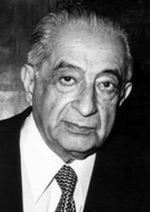
Konstantinos Tsatsos
Konstantinos Tsatsos (1899-1987). Konstantinos Tsatsos was born in Athens, the eldest son of lawyer and politician Dimitrios Tsatsos and Theodora Eustratiadi, originally from Trieste. He had a younger brother named Themistocles. He attended Makris School, the Second Gymnasium of Neapolis, and the Teachers' Training College for Secondary Education. He also took private lessons at home with Jules Basset, who introduced him to literature, and was childhood friends with poet Alexandros Empeirikos. He studied at the Law School of the University of Athens (1914-1918). After graduating, he worked in Paris with the Greek delegation at the Peace Conference under Eleftherios Venizelos. During his military service (1920-1923), he became friends with Kostis Palamas. In 1924, he married Lili Zarini, but the marriage was short-lived. From 1924 to 1928, he studied philosophy and philosophy of law in Heidelberg, influenced mainly by his professor Heinrich Rickert. Upon returning to Athens, he took over his father's law firm and in 1929 earned his doctorate from the Law School with a dissertation titled "Law as Technique and Science." He co-founded the journal "Archive of Philosophy and Theory of Sciences," an organ of idealistic philosophy, with Panagiotis Kanellopoulos, Ioannis Theodorakopoulos (with whom he had a long-standing friendship that began in Heidelberg), and Michalis Tsamados. In 1930, he married Ioanna Seferiadi, with whom he had two daughters, Despina and Theodora. That same year, he was elected as a lecturer at the Law School of the University of Athens with a focus on the Philosophy and Science of Law. Two years later, he was appointed as an associate professor in the newly established chair of Introduction to the Science of Law and Philosophy of Law and published the book "The Problem of Legal Interpretation." During the Metaxas dictatorship, his candidacy for a full professorship was rejected, and Tsatsos was exiled to Skyros (1939) and Spetses (1940). After the outbreak of the Greco-Italian War, the regime refused his request to enlist voluntarily and instead placed him (along with I. Kakridis and I. Theodorakopoulos) in the Intellectual Mobilization of the War. During the German occupation, he participated in a group that helped smuggle Greek and British officers and was involved in the organizations EOCHA, EKK, and the Socialist Union (a short-lived political organization with anti-monarchist and anti-communist orientation). He was dismissed from his university position and persecuted after declaring the eve of October 28, 1941, as a national day of freedom in the amphitheater. From 1944 to 1945, he fled to the Middle East, where he was appointed technical advisor to the exiled Tsouderos government. He returned to Greece after the liberation and resigned from the university in 1946. He served as Minister of the Interior and Welfare (1945), Member of Parliament for Athens (1946), Minister of National Education and Religious Affairs (1949-50), Deputy Minister of Coordination (1950-1951), Minister of the Presidency (1956-1961), Minister of Social Welfare (1962-1963), Minister of Justice (1967), Minister of Culture (1974), and the first President of the Hellenic Republic (1975). In 1953, he traveled to the USA, where he taught for two years at the free university of Evangelos Papanoutsos in Athens. He was a co-founder of the National Radical Union (ERE). In 1961, he was elected a regular member of the Academy of Athens and became its president in 1965. During the Papadopoulos dictatorship, he participated in the publication of the "History of the Greek Nation" by Ekdotiki Athinon. In 1975, as President of the Constitutional Committee, he ordered the burning of the political dossiers of the Ministry of Culture employees, which had been compiled by the dictatorial regime. He was an honorary doctor of the Sorbonne University, a foreign associate of the Academy of Moral and Political Sciences of Paris (1979), a foreign associate of the Royal Academy of Morocco and the Academy of Romania (1980), and a member of the European Academy of Sciences, Arts, and Letters. For promoting the idea of a United Europe, he was honored with the Coudenhove-Kalergi Foundation Prize. He passed away in 1987 at his last residence in Kifisia. For more biographical details on Konstantinos Tsatsos, see Kostas E. Tsiropoulos, "Tsatsos Konstantinos," World Biographical Dictionary 9b, Athens, Ekdotiki Athinon, 1988; Despina Mylonas, "Chronology of Konstantinos Tsatsos," Epta Imeres Kathimerini, 19/10/1997, pp. 3-7; and Despina Mylonas-Tsatsou, "Biographical Timeline of Konstantinos Dim. Tsatsos," Nea Estia 142, Christmas 1997, no. 1690, pp. 3-10. (Source: Archive of Greek Authors, E.KE.BI.).
-
Greek Fiction Books
-

All categories

Categories
 Greek Fiction Books
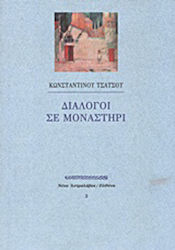
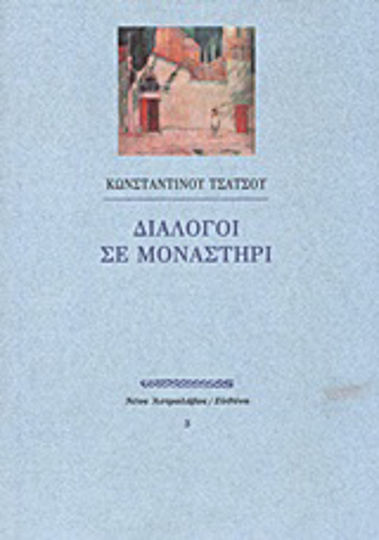
Διάλογοι σε Μοναστήρι, Texts of Reflection
Konstantinos Tsatsos, 2011 , Responsibility
from11,84 € at 2 stores0