THrasos Kastanakis
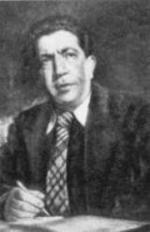
THrasos Kastanakis
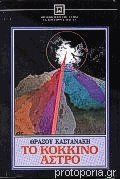
Thrasos Kastanakis (1901-1967). Thrasos Kastanakis was born in Tatavla, Constantinople. He had two older brothers and lost his mother during childhood. He spent his childhood and teenage years in Tatavla, where he formed a friendship with Lysandros Prasinos, a French teacher and co-publisher of the political magazine "Logos." This friendship sparked Kastanakis's love for French literature and inspired his first writing attempt, the short story "Frightened Soul," written during his school years (1918). During the same period, he published a study on Arthur Rimbaud, who was almost unknown in Greece at the time, and in 1919, shortly after graduating from the Lycee National Francohellenique, he left for Paris with his friends Giorgos Vakalo and Antonis Giannidis. There, he studied at the School of Oriental Languages at the Sorbonne University. He graduated with honors in 1921 and was appointed as a curator in the Department of Byzantine and Modern Greek Philology at the same school, under the direction of Yiannis Psycharis. In 1929, he married philologist Angela Valiadou. Their marriage lasted three years, and immediately after their divorce, Kastanakis married Angela's student, Elpida Mavroeidi, who was from Cairo. Mavroeidi was his long-term partner until her death from cancer in 1964. He returned to Greece shortly before October 28, 1940, and lived in Athens throughout the German occupation. After the liberation, he returned to Paris, where during the civil war, he engaged in political activities in support of the Left, founding the Democratic Union of Greeks in France and denouncing the persecution of his like-minded compatriots in Greece through speeches and publications in English and French media. He spent the rest of his life in Paris, which became particularly lonely and painful after the death of his second wife. In his later years, he suffered from alcoholism and contracted liver cirrhosis, a disease that led to his death. He was buried in Paris. His first official appearance in literature was in 1921 with the publication of his poetry collection "The Deserts of Heliocharos" in Constantinople, parts of which he had previously published in the magazine "Logos." He also published literary works in the short-lived magazine "Dionysos" (Constantinople), where he was also a co-publisher. In 1924, he was awarded in the novel competition of the publishing house of Michael Zikakis with his work "Princes." From then until the last years of his life, he turned almost exclusively to prose, leaving behind a large body of work consisting of fifteen novels and eighty-six short stories, much of which remains unpublished. His known published works include: "Princes," 1924, "In the Dance of Europe," 1929, "The Tribe of Men," 1932, "The Homogeneous Vladimir," 1936, "In the Time of Peace," 1942, "Betrayed France," 1945, "Haji Manouil," 1956, "The Red Star" (posthumous publication, 1985). He also wrote critical essays, articles, and studies for magazines such as "Noumas," "Kyklo," "Elefthera Grammata," and "Art Review." He maintained a close relationship with the theater, and his writing was influenced by theatrical techniques. He collaborated as a theater correspondent with Parisian and Athenian magazines. His works have been translated into French and Italian. Thrasos Kastanakis's literary work is situated within the tradition of Greek diaspora literature. In his early career, he was strongly influenced by his mentor, Giannis Psycharis, whose work and personality he deeply admired despite their conflicts. From Psycharis, Kastanakis inherited a lifelong commitment to using an artificial demotic language in his work, as well as the elevation of Greece to a supreme Idea, to which he was devoted throughout his life. His work expresses his theory of Greekness and his ideological rather than experiential nostalgia for the Greek world. He had natural ties only to his birthplace, which he nostalgically recalls mainly in his later works. His writing is also infused with elements from his European education, his long stay in France, and his ideological alignment with the Left. A primary goal of his work is the study and critique of the mechanisms of urban life, with an emphasis on the contrast between the bourgeois and the popular classes. His prose incorporates numerous experiments in technique and style, bordering on realistic psychography, with interspersed elements referencing the literary movements of aestheticism, exoticism, and interwar modernism. For more biographical details on Thrasos Kastanakis, see Dimitris Giakos, "Kastanakis Thrasos," "Great Encyclopedia of Modern Greek Literature," 8. Athens: Haris Patsis, n.d., Alexis Ziras, "Kastanakis Thrasos," Encyclopedia "Papyros-Larousse-Britannica," 32, p.595. Athens: Papyros, n.d., Vicky Kalantzopoulou, "Kastanakis Thrasos," "World Biographical Dictionary," 4. Athens: Ekdotiki Athinon, 1985, and G.D. Paganos, "Thrasos Kastanakis," in "Interwar Prose: From the First to the Second World War (1914-1939)," D, pp.346-390. Athens: Sokolis, 1992. (Source: Archive of Greek Authors, EKEBI).
0
 Greek Fiction Books
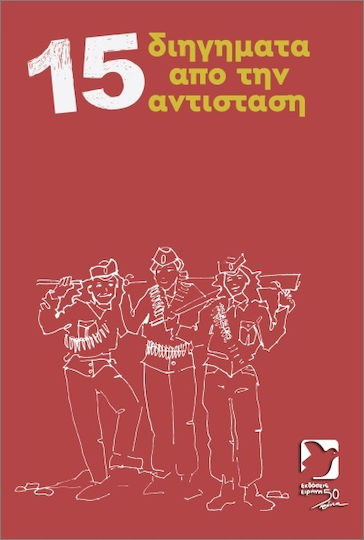
15 Stories from the Resistance
Menelaos Lountemis, Ilias Venezis et al., 2024 , Eirini Publications
from11,25 € at 2 stores0