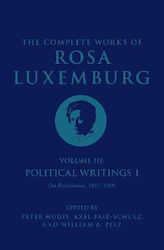
Rosa Luxemburg
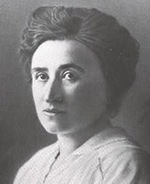
Rosa Luxemburg
Rosa Luxemburg was one of the most pure, consistent, and independent figures of the global socialist movement. She was born in 1871 in Zamość, then under Russian-occupied Poland, and was the youngest of five children in a Jewish middle-class family with progressive and cosmopolitan views. At the age of five, her life was threatened by a severe illness that left her with a lifelong disability in one of her legs. Rosa Luxemburg began her illegal political activities during her high school years in Warsaw. At the age of 18, in 1889, to avoid arrest, as many of her compatriots did at the time, and to continue her studies, Rosa emigrated to Switzerland where she studied law and political economy. During her student years in Zurich, Luxemburg met many prominent Russian social democrats, such as Plekhanov, Axelrod, and others. It was during this period that her relationship with her like-minded Leo Jogiches began, who remained a lifelong friend and for a time, her lover. In 1898, Luxemburg received her doctorate from the University of Zurich. That same year, she married Gustav Lübeck to acquire German citizenship and settled in Berlin with the aim of working within the ranks of the German Social Democratic Party, the strongest of the Second International. By then, Luxemburg had already expressed sharp theoretical disagreements with both the Polish and Russian Social Democratic parties. The main point of her opposition concerned the issue of Polish self-determination, which both parties advocated. Luxemburg believed that self-determination essentially weakened the global socialist movement and did nothing but strengthen the dominance of the bourgeoisie in the states that gained independence. For Luxemburg, the great strength of the socialist movement was its internationalist character. Another target of Luxemburg's disagreement was the German social democrat Eduard Bernstein, the father of revisionism, who argued that Marxist theory needed a radical revision, particularly regarding the necessity of revolution. Bernstein posited that, especially in industrially developed countries, revolution as a means for social change had become unnecessary and that socialists should pursue their goals through parliamentary and trade union actions. With her work "Social Reform or Revolution?" (1900), Luxemburg strongly opposed these views, steadfastly insisting on the necessity of revolution as a means for social change. Continuing her intense political activity with numerous publications, speeches, and organizing demonstrations, and in constant conflict with the authorities, Rosa Luxemburg always fought on two fronts: on one, she faced the eternal political and class enemy, the bourgeoisie, and on the other, her fellow socialists. She was also critical of Lenin on many points of his theory and practice. Her relevant criticism is wonderfully summarized in the words she addressed to Lenin, pointing out that he had not imposed the dictatorship of the proletariat, as he claimed, but a dictatorship over the proletariat. During the years of World War I, Luxemburg spent a significant amount of time in prison. Disagreeing with the German Social Democratic Party, which supported the German war effort, Rosa Luxemburg, along with Karl Liebknecht, founded the Spartacus League. This organization aimed to end the war and later evolved into the German Communist Party. In 1919, in Berlin, members of a paramilitary organization brutally murdered Rosa Luxemburg and Karl Liebknecht under unclear circumstances and disposed of their bodies in a canal. During her lifetime, although Rosa Luxemburg fought tenaciously, she was unable to bring her views on socialism to fruition. After her death, despite the enduring respect for her among Marxists, her beliefs were fiercely opposed by the Soviet establishment. In recent years, however, especially following the liberalization of the former USSR and its eventual collapse, interest in Luxemburg's theories has been rekindled. The "Red Rosa," as she was called, is now considered the ideological founder of "socialism with a human face."