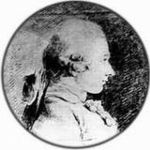
Donatien Alphonse François de Sade
Donatien-Alfonse-Francois De Sade was born in Paris on June 2, 1740. A descendant of a prominent aristocratic family from Provence (son of Marie-Eleonore De Maille De Carman and Jean-Baptiste-Joseph Francois De Sade, Lord of Saumane and La Coste), he was enrolled at the age of ten in the Jesuit college of Louis the Great. At fourteen, he began his studies at a military academy and participated a year later in the Seven Years' War of France against Prussia. In May 1763, he married Renée-Pélagie De Montreuil and had two sons. The year of his marriage, he was imprisoned in Vincennes by royal decree, accused of debauchery for orgies in a brothel. This imprisonment marked the beginning of a long series of incarcerations in prisons or asylums for the insane, lasting 30 out of the 74 years of his life. He was released a month later but placed under house arrest. In 1767, his first son was born. In 1771, he was sentenced to death for the first time in Marseille, accused of murder by poisoning. He was arrested, symbolically executed, and escaped. He was imprisoned again for five years in the castle of Vincennes. He escaped and returned to La Coste in 1776. The following year, Trillet, the father of a maid in La Coste named Justine, attempted to take his daughter back and shot Sade. Investigations began. Thus, the three of them, Mr. and Mrs. Sade along with Justine, arrived in Paris, and Mrs. Sade informed her mother. Sade was arrested again and confined in Vincennes. Mrs. Sade and her mother requested the annulment of his 1772 conviction. The following year, he also appealed to the Court of Provence. In July 1778, the Court found him guilty only of orgies and excessive libertinism, acquitted him of the charges of poisoning and sodomy, and imposed a disciplined lifestyle and a ban on entering Marseille for three years. He returned to Vincennes but was imprisoned again despite his acquittal based on the lettre de cachet of February 13, 1777. He escaped again and returned to La Coste, but after two months, he was arrested again and imprisoned in Vincennes. He dedicated himself to writing plays and novels. He completed "Dialogue Between a Priest and a Dying Man" in July 1782. In 1784, he was transferred to the Bastille prison. There, a few years before the outbreak of the French Revolution, he began writing "The 120 Days of Sodom" (1785) on a 12-meter-long roll of paper. He also wrote the first draft of "The Misfortunes of Virtue." In 1788, he began and completed "Eugenie de Franval" in six days. In the Bastille, from where he would be transferred to the Charenton asylum ten days before its fall, he left behind his rich library of 600 volumes and his manuscripts. On July 14, 1789, the Revolution stormed the Bastille, looting all his belongings, furniture, books, and manuscripts that Mrs. Sade had not managed to retrieve.
He was released by decree of the Constituent Assembly, which stipulated that no one could be detained without judicial decisions, in 1790. Mrs. Sade had taken refuge in the Saint-Or convent and refused to see her husband, even filing for and obtaining a divorce. Sade acquired the identity of an "active citizen" of the Place Vendôme district. The Italian Theatre agreed to stage his one-act play "Le Suborneur." The Comédie-Française unanimously accepted his five-act play "The Misogynist Out of Love" or "Soli & Defranc." In 1791, he anonymously published "Justine, or the Misfortunes of Virtue." The play "Oxtiern, or the Consequences of Libertinage" was staged at the Molière Theatre. A second performance on November 4, 1791, caused disturbances and led to the suspension of the play. At the end of 1793, a warrant was issued for his arrest due to a letter he had written two years earlier to the Duke de Brissac, commander of Louis XVI's guard. He was imprisoned at Madelonnettes, then transferred to the Carmelite prison, and later to Saint-Lazare. He was sentenced to death for the second time, this time by the Revolution, narrowly escaping the guillotine, and was released in 1794. Surviving solely on the income from his writing, he published his works in 1795: "Philosophy in the Bedroom," "Aline & Valcour," the new "Justine, or the Misfortunes of Virtue," followed by "The Story of Juliette, Her Sister, or the Prosperity of Vice." The enumeration and description in these works of every form of erotic behavior, which he conceived as a just rebellion of the individual against society and God, were once again condemned by the press and authorities. He sold La Coste in 1796. In 1799, "Oxtiern" was performed again, and he took a small role. Critic Villeterque violently attacked "Crimes of Love," which had just been published in 1800, and in the same article attributed the authorship of "Justine" to him. In 1801, the police seized his work at the printing house. They also arrested his publisher, Massé, who revealed where "Juliette" was stored. Sade denied authorship of "Justine." The Chief of Police and the Minister of Security decided that a trial would cause a major scandal that an exemplary punishment would not mitigate. Thus, without a trial, they agreed to his imprisonment at Sainte-Pélagie as an administrative penalty. Two years later, he was transferred to Bicêtre. From there, with the consent of his family, he was once again taken to the Charenton Asylum for the Insane. Director Dubois described him as incorrigible, living in a state of constant lascivious disturbance, and recommended the continuation of his detention in 1804. In 1806, he drafted his will. The following year, he completed the 10-volume work "The Travels of Florbelle," which the police immediately confiscated and his heirs burned after his death. In 1811, the Council of Ministers, presided over by Napoleon the Great, decided to continue his detention and banned therapeutic theatrical performances at the Asylum, where Sade held the main role. In 1813, he completed "The Secret History of Isabella of Bavaria," and the novel "La Marquise De Ganges" was published anonymously. There, at the Charenton Asylum, in full mental clarity, he died on December 2, 1814.
 Greek Fiction Books
 Greek Fiction Books
 Greek Fiction Books
 Greek Fiction Books
 Greek Fiction Books
 Greek Fiction Books