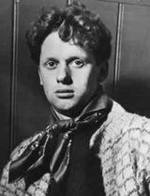
Dylan Marlais Thomas
Welsh poet, prose writer, screenwriter, and playwright. Born in Swansea, Wales, on October 27, 1914, in an environment marked by tensions between the English-speaking and local cultures, although he never learned Welsh himself. He published his poems in English for the first time in the newspaper "Sunday Referee," in the "Poet's Corner" column, in 1933. Their recognition led the publisher Victor Neuburg to print them in 250 bound copies the following year, titled "18 Poems." In 1937, Dylan Thomas married Caitlin Macnamara, with whom he would have three sons. The couple settled in Laugharne, Wales. His second poetry collection, titled "25 Poems," was published in 1936, and the short story collection "Portrait of the Artist as a Young Dog" was released in 1940. Besides poems, Dylan Thomas wrote short stories, scripts for cinema (Strand Films) and radio (BBC), as well as the radio play "Under Milkwood," which continues to be performed today. In 1953, at the age of 39, with health deteriorated by alcohol, during his fourth lecture tour in the United States, Dylan Thomas collapsed at his hotel in New York. He died on November 9, 1953, at St Vincent's Hospital, and his body was transported and buried in his homeland.
His works include: "The Map of Love," 1939, "The World I Breathe," 1939, "Portrait of the Artist as a Young Dog," 1940, "New Poems," 1943, "Deaths and Entrances," 1946, "Collected Poems, 1934-1952," 1952, "The Doctors and the Devils," 1953. Posthumously published works include: "Under Milkwood," 1954, "Quite Early one Morning," 1954, "Adventures in the Skin Trade and Other Stories," 1955, and the short stories "A Prospect of the Sea," 1955. Dylan Thomas's poems have been translated into Greek by Giorgos Blanas, Lydia Stefanou, Nanos Valaoritis, and T. Porphyri and St. Rozanis.
As translator Miranda Stavrinou notes: "Dylan Thomas's writing is characterized by a uniqueness that differentiates his work to such an extent that it renders any attempt to compare it with the work of his contemporaries futile. When surrealism was still at the forefront of global literature in the 1930s, Thomas invented new functional relationships in literary language. From his early autobiographical stories, he gradually reached the dramatic objectivity of his later prose and poetry, as aptly noted by K. Fryer. A demonically poetic nature, Thomas retrieved the word from the decay of everyday friction and placed it on a symbolic conceptual level that extends to a metaphysical vision. Dylan Thomas plays with words, combining colloquial language with archaic expressions, embedding idiomatic and slang words among them." The densely alternating images, the long paragraphs that flow with a single breath, the peculiar use of syntax, the richness of resonances, the invention of words, the wordplay, the deliberate obscurity of words, and the musical flow of his expression testify to an exhausting wordsmith who seeks, "presses and molds" the word to ultimately give it a semantic choice, a spectrum of emotional and metaphysical meanings. D. Thomas is considered today one of the most prominent figures in contemporary prose and poetry. Critic J. W. Lambert wrote in the Sunday Times that "... D. Thomas has established himself as an artist who succeeded in creating poetry in prose form."
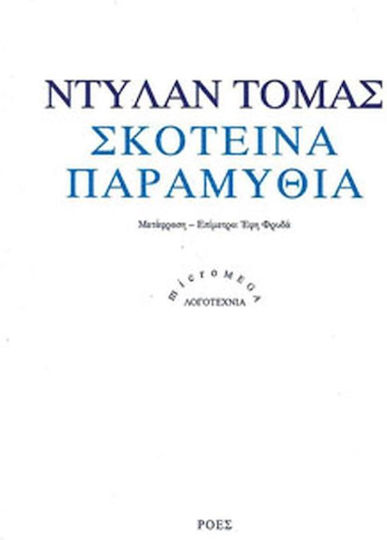
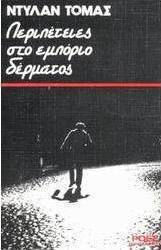
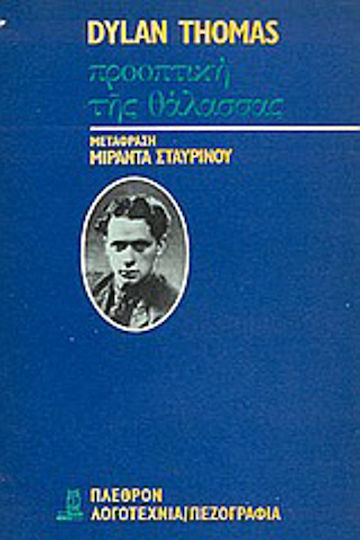 Greek Fiction Books
 Greek Fiction Books
 Greek Fiction Books
 Greek Fiction Books