Bruce Chatwin
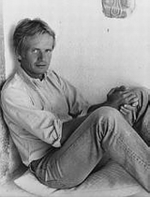
Bruce Chatwin (1940-1989) was born near Sheffield, England, and passed away in Nice, France. He began his career as a junior employee at the London auction house Sotheby's, where he quickly rose to a high managerial position. After leaving this role, he intended to study archaeology but did not complete his studies. He also ventured into journalism, which did not captivate him either. Chatwin became famous as a travel writer, journeying to places such as Peru, Patagonia, West Africa, Australia, and more. He also visited Greece, where he was often hosted at the home of his mentor Patrick Leigh Fermor in Kardamyli, Mani. His books reflect his travel experiences. Some criticized him for his tendency to mix factual events with fictional details, which sometimes upset the people he encountered on his travels. Chatwin responded that his intention was not to faithfully reproduce what he saw. He was extremely sociable, with numerous friends and acquaintances. Chatwin was also bisexual, with the knowledge of his wife, Elizabeth Chanler—whom he met as a secretary at Sotheby's—who accepted this throughout their life together, although they separated after fifteen years of marriage. She was by his side again during the final phase of his life, caring for him until his death from AIDS (one of the first victims of the disease in the UK). At Chatwin's funeral, held at the Greek Orthodox Church in London, writers such as his friend Paul Theroux and Martin Amis were present. He requested that his ashes be scattered outside a Byzantine chapel in Mani. Chatwin's first published book was "In Patagonia" in 1977. This was followed by "The Viceroy of Ouidah" in 1980, "On the Black Hill" in 1982, "Patagonia Revisited" in 1985, "The Songlines" in 1987, and "Utz" in 1988. After his death, his works "What Am I Doing Here" in 1989, "Photographs and Notebooks" in 1993, and "Anatomy of Restlessness" in 1997 were published. In 1999, his biography "Bruce Chatwin: A Biography" (Greek edition "Μπρους Τσάτουιν," Hatzinikoli, 2001) was released, written by Nicholas Shakespeare.